
Historical Simulation: Full vs. Delta Valuation
The purpose of historical simulation is to determine what gains or losses would be incurred if a market price development from the past were to occur today. Broadly speaking, there are two calculation methods, full valuation and delta valuation:
Full valuation:
If you use the full valuation method for historical simulation, n comparative NPV calculations are made with the market data changes over the historical period. In this case, the system calculates fictitious present values for all the flows in the historical period on the basis of the valid market data.
In order to simulate the present value changes, the current present value is multiplied n times by the market data that has been adjusted for the historical changes.
These simulated NPVs are compared with the NPV calculated from current market data. This produces n potential gains/losses.
The calculation is carried out for the historical changes to each risk factor in the risk hierarchy. In other words, the values are recalculated for each node in the risk hierarchy, taking into account all the historical changes to the risk factors under that node.
The correlation of individual market prices and the relation between positions is implicitly taken into account, as the NPVs for every business event in the historical period are calculated based on all market data currently available.
Gains and losses are sorted by amount.

The relative frequency of the profits and losses is calculated. If there is a large enough sample (n), the distribution will represent an actual frequency distribution of profits and losses.
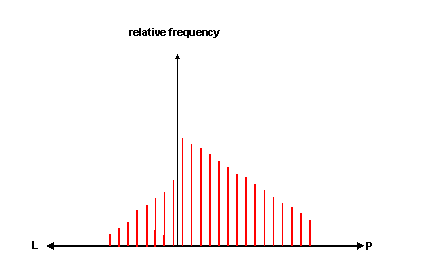
By entering a confidence level, a VaR is calculated from the distribution of gains and losses. This VaR represents a particular amount, which nothing, with a certain probability, will drop below.

With 200 checked values and a confidence level of 99%, the third largest loss represents the VaR.
Delta valuation:
With the delta valuation, the NPV is not calculated for every business event in the historical period. Instead, the elasticity of the price function is estimated for the different price parameters, independent of historical market prices. The NPV differences result from weighting the sensitivity with the price differences from the historical market data. As with full valuation, this results in n potential profits/losses, whose relative frequency distribution can be represented using full valuation.
At the heart of this approach is the assumption that the NPV function is linear. This assumption also lessens the number of calculations necessary to perform the valuation.
