 Transaction Types
Transaction Types
Use
Within Asset Accounting, asset transaction types identify individual business transactions. A transaction type has to be entered for each transaction that affects assets. Either you make this entry yourself in the posting transaction, or the entry is automatic, based on specifications made in FI-AA Customizing (Transactions).
Features
Each transaction type is assigned to a transaction type group. The business transactions are subdivided on the basis of the transaction type group into:
Specifications (Transaction Type Group)
The transaction type group, to which a which a transaction type belongs, determines the following:
The number of possible transaction type groups, as well as the characteristics of the individual groups, is specified in the system and cannot be changed.
The system carries out a check for the asset class of the fixed asset involved when you post with a transaction type of the down payment group. This means that you can only post to fixed assets using these transaction types if you defined this in the asset class.
Specifications (Transaction Type)
The individual transaction types determine the following:
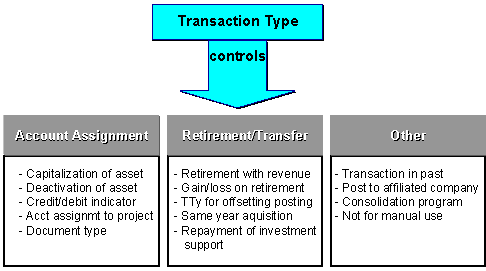
Specifying Transaction Types
Some of these specifications are dependent on the transaction type group, and are mutually exclusive. You cannot make specifications that are inconsistent with the transaction type group.

SAP provides a number of transaction types that cover most common business transactions. Unlike the transaction type groups, you can add new transaction types as needed. In order to prevent the transaction types that you define yourself from being overwritten during a release upgrade, you have to enter the letter x, y, or z at any position in the three place transaction type key.