 Forward Rates
Forward Rates
Definition
Forward rates or implied forward rates are interest rates for transactions that are in the future but that are determined by a current yield structure curve.
Use
Taking interest incurring up until the start of the term into account, the system calculates interest rates for terms in the future, an interest rate for the term of 6 months, for example, with a term starting 3 months from the current date.

Calculation of the forward rates is based on the zero bond discounting factors of a current yield structure curve. This can be identified by the yield curve type and the currency and depends on the respective type of the interest rates (par rates as opposed to zero bond rates). No forward par rates are calculated for yield curves of the yield category zero bond yield.
t0 < t 1 < t 2
d : days between t1 and t 2 according to the interest calculation method, where d = t 2 - t 1
b : annual base days according to the interest calculation method
dt: term of the annual grid value before t 1
FRt0: forward zero bond rate for the period t 1 to t 2 based on the yield structure curve valid in t 0
ZBDFt1: the zero bond discounting factor that applies for the discounting of t 1 to t 0
ZBDFt2: the zero bond discounting factor that applies for the discounting of t 2 to t 0
Calculation of the forward zero bond rates results from the following formula:
 where d £ 1 year
 where d > 1 year
The forward zero bond discounting factors are determined from these forward zero bond rates:

Calculation of the forward par rates (only for yield curves of the yield category par rate) results from the following formula:
 where d £ 1 year
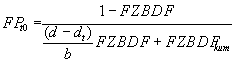 where d > 1 year
Example
Forward zero bond rate for the term 180 days in 90 days
t0 = 0 : calculation time
t1 = 90 days
t2= 270 days
Interest calculation method: 30/360
FRt0: Forward rate for the period t1- t2 based on the yield structure curve valid in t0
ZBDFt1 = 0,98619: the zero bond discounting factor that applies for the discounting of t1 to t0
ZBDFt2= 0,95790: the zero bond discounting factor that applies for the discounting of t2 to t0
