Revaluation of Assets at Regular Intervals
Revaluation of Assets at Regular Intervals
Purpose
This process illustrates how you can use the SAP System to automatically revaluate your assets. For the purposes of this example, we assume:
Process Flow
The system debits the
acquisition and production costs (APC) to the asset subledger account for drilling equipment and credits the vendor's account (see graphic below); the transaction is automatically recorded on the asset reconciliation account in the general ledger.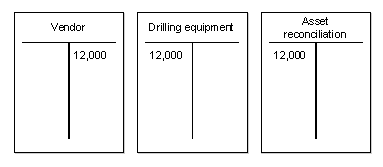
The system automatically calculates the planned depreciation amounts for the entire year in the asset subledger, but without yet posting them to the general ledger. The equipment has a useful life of 10 years and is to be depreciated using the straight-line method without any scrap value. That means that one month's depreciation is UNI 100.
 execute a depreciation posting run.
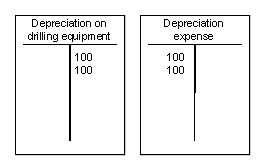
The program posts the depreciation amount – UNI 100 – to the general ledger as follows:
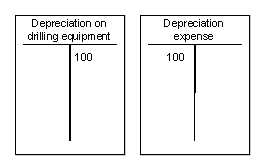
Note that there is no revaluation amount for this month, as in this example, assets are not to be revaluated in the same month as they are acquired.
The program:
The inflation rate is currently running at 10% a month, which means that the equipment, which was originally worth UNI 12,000, is now worth UNI 13,200, a
Note that the program creates these documents in a batch input session, which you then have to process in order for the document to be posted to the subledger (see step 4).
Now that the equipment's value has increased, the original monthly depreciation of UNI 100 will not be enough to fully write off the asset over 10 years. For this reason, the monthly depreciation amount has to be extended to cover the revaluation amount (UNI 1,200).
The system calculates the depreciation on the revaluation amount by using the same rules as it used to calculate the unadjusted depreciation, so spread over the asset's useful life of 10 years, the UNI 1,200 has to be depreciated at UNI 120 per annum, or UNI 10 per month.
The system posts the asset revaluation documents, which serve to update the revaluation amounts in the asset subledger.
The program:
The program creates an
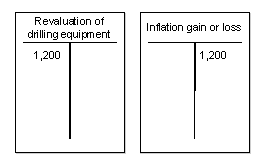
The graphic shows the UNI 100 for January and the UNI 100 for February.
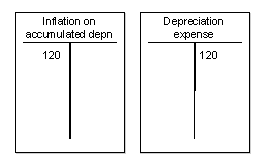
Although January has already passed, the revaluation amount is typically still depreciated equally over the 12 months of the year. For this reason, that means that we now depreciate not just UNI 10 for February, but also UNI 10 for January as well, a total of UNI 20. The posting is as follows:
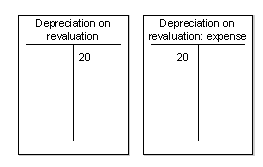
After these postings have been made, the revaluated net book value of the drilling equipment is:
(APC + revaluation amount) – (depreciation on APC + depreciation on revaluation amount)
Or
(UNI 12,000 + UNI 1,200) – (UNI 200 + UNI 20) = UNI 12,980.
To cross-check the result, we can work out what the unadjusted net book value would have been at the end of the month:
UNI 12,000 APC – UNI 200 depreciation = UNI 11,800
We can then adjust this amount for inflation:
UNI 11,800 ´ 10% inflation = UNI 1,180
If you add the revaluation amount to the unadjusted net book value, you get the same amount, UNI 12,980.
Note that in some countries, you are required to use separate G/L accounts to record revaluation of the current month's depreciation amount; and revaluation of that from previous months. For more information, see
At this point, the whole year's depreciation and revaluation amounts have been posted to the general ledger.
You also
change the fiscal year. When you do so, the system automatically carries forward the accumulated depreciation to the new fiscal year.