 Transportation Planning Interface
Transportation Planning Interface
The SAP R/3 system offers automated support for external optimizing transportation planning, since the huge number of different possible transportation processing procedures and optimization criteria require software that is exactly adapted to the customer’s needs.
The use of specialized software components is becoming increasingly important as a way to optimize the efficient planning of transportation requirements. The SAP R/3 system offers automated support for external optimizing transportation planning, since the huge number of different possible transportation processing procedures and optimization criteria require software that is exactly adapted to the customer’s needs.
To meet these special customer requirements for transportation planning, you can set the SD-TPS interface described below between the SAP R/3 system and one or more specialized, external transportation planning systems (TPS).
Process Flow Overview
During the standard business process in R/3 you create a shipment and are given a selection of deliveries, that are to be planned for the shipment. This process is mainly carried out manually.
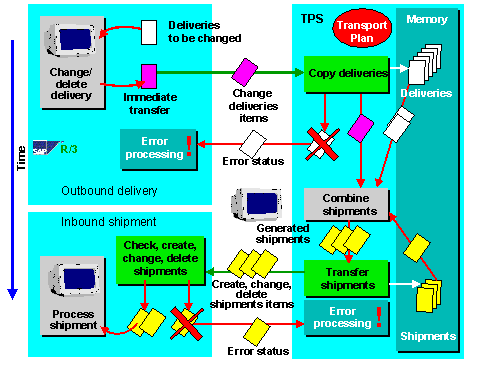
When an external system is used for transportation planning, are record of deliveries to be transported is selected in R/3 and is sent to the planning system. There, the deliveries are combined into shipments according to different optimization criteria. The shipments created are sent back via the interface to R/3 and are then used for generating shipment documents in the R/3 system. The master data (e.g. customer address, goods receiving hours) must be the same in both systems for the shipment documents to be posted correctly.
The creation and changing of shipments is carried out in the transportation planning system. All other processing stages for the shipment (printing papers, transportation start etc.) are carried out in the normal way in R/3.
Organizational Linking
The organizational linking of an external transportation planning system is carried out in R/3 by assignment to a transportation planning point. The planning system also has the function of an external transportation planning point. Only one planning system can be assigned to an external transportation planning point. It is, however, possible to assign several transportation planning points to a planning system, if different MRP controllers have to work with the same system.
Functions
The SD-TPS interface supports the following functions:
SAP to transportation planning system:
Transportation planning system to SAP:
Partner Concept
In order to provide our customers with a flexible and secure link to the transportation planning system, we will work together with selected partners. The responsibilities are distributed between SAP and its partners as follows:
SAP delivers the technical tools necessary for a connection to an external system (IDocs, ALE, RFC) as part of the standard release as of 3.1. On the application side, functions (transactions, standard IDocs, Customizing) are provided that represent relevant business processes and allow the corresponding processing to be carried out in the R/3 system.
The partners are responsible for all processing procedures between data being transferred from and returned to the R/3 system. In other words, the correct interpretation of R/3 data, planning of shipments according to requirements, the data transfer back to the R/3 system in the correct format and the technical communication between the computer systems. One of their most important tasks is that of the first contact partner for customers if errors occur during communication of data.
A certification procedure is provided for the partner, to check whether the partner meets the requirements for successful connection of an external system to the SAP R/3 system using the technique described above. The functionality of the partner application software will not be checked.
Technical Information
The interface uses the transaction Remote Function Call (tRFC). This is a simplified procedure that makes program to program communication possible.
Unlike the synchronized Remote Function Call (sRFC) the tRFC saves data before it is transmitted. This unlinks application and communication.
SAP provides streamlined monitoring for the logical analysis of errors. Furthermore, a message is sent to the person or people responsible if an error occurs. Their inboxes are set to allow follow-up posting.
Certification Requirements
SAP will issue a certificate if a partner can prove correct transfer and functionality for all IDoc connections and the test scenarios provided. The list of IDocs required to obtain the certificate can be seen in the description of the IDocs.