 Process Flow: Demand Planning
Process Flow: Demand Planning
Purpose
Although R/3 has its own forecasting functionality, the DRP interface provides the external system with a communication channel for forecasting demand at many different levels. The external system can then either send the forecast results back to R/3 or use them for further distribution planning.
Process Flow
The following diagram illustrates the business processes:
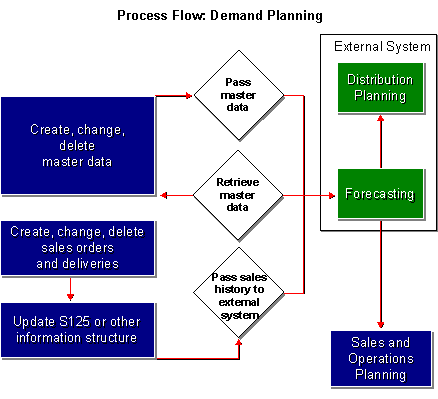
Demand history is collected through R/3’s SIS (Sales Information System). R/3 has several options for configuring the collecting process so that the data records in the information structure reflect the exact data that the external system requires for demand planning.
Information structure S125 is designed for the DRP interface. It collects demand history from both sales documents and delivery documents and aggregates these quantities based on the six characteristic values defined within the structure. However, the external system should not be limited to S125. S125 is provided as a sample setup. Often customers will have to create their own information structures for collecting the specific data needed for their own forecasting purposes. However, processing the customer-specific information structure may pose technical difficulties for the external system if it can not provide configuration options at installation time.
The combination of the characteristic values in an information structure determines the lowest level where history resides. Based on the forecasting scenario and requirements, the external system is expected to map and aggregate the demand history. The mapping and aggregation should be designed as the customization options.
An update of the information structure takes place whenever there is a transaction for the sales orders and delivery documents. Program RBDMCCOP, which also has the net change feature, is used to transfer the demand data into the external system. Program RMCPMANU, which transfers all the demand history within a specified period, is used in conjunction with S125. These programs are usually run manually when forecasting is not implemented too frequently.
Result
Once the external system finished forecasting, it can send the results back into R/3 through ALE message type LIP076, which uses the results to fill in the sales quantity for SOP planning table S076 (message LIP076 uses IDoc SOPGEN01 and links to function module IDOC_INPUT_LIPGEN). If the external system has its own distribution-planning module and needs these results, the data remains in the external system for further processing.