
ALE: Concepts and Design
The ALE (‘Application Link Enabling’) concept available in R/3 Release 3.0 supports the construction and operation of distributed applications. It includes a business-controlled message exchange with consistent data on loosely-linked SAP applications. Application is not achieved using a central database but using synchronous and asynchronous communication.
The DRP interface takes advantages of ALE’s design for exchanging high volume data efficiently and consistently between the external planning system and R/3. While ALE outbound is used to transfer master data and transaction data to the external system, ALE inbound is used for the external system to pass planning results into R/3 and create relevant data objects. The following diagrams illustrate both ALE outbound and inbound processing.
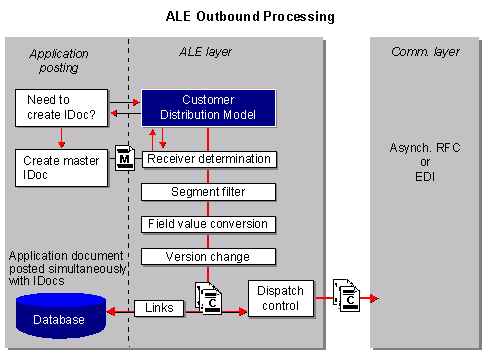

The basis for data exchange is the intermediate document (IDoc), which is a general data container that can contain any desired R/3 application data. Different application data can be packed into the same type of IDoc. IDocs differ from each other by having different message types.
IDocs usually have a hierarchical structure so that all the information of a data object (such as a production order or a sales order) can be contained in a single IDoc. An IDoc type consists of three record types: control, data, and status records. To extract data from R/3, the external system must be able to recognize the IDoc structure and read the data content from data records based on the message type and the IDoc type information stored in the control record. To transfer data back into R/3, the external system needs to populate the IDocs properly with the data it has generated. The details on the IDoc structure can be found in the SAP document ‘The IDoc Interface for EDI’, and the description of the IDoc’s used for DRP interface can be found in section ‘IDoc Description’ of this document.
ALE typically uses TCP/IP to connect with the external system. This requires a series of setups that define the correct communication channel. Also, ALE uses distributed customer models to control data distribution and ensure the correct data flow. More specific configurations are available through ‘Partner Profile’, which also controls the type of data flow between R/3 system and the external system.
ALE also provides error-handling functionality, which can be configured so it links to workflow engine within R/3. IDoc data processed through ALE can be monitored and archived so that the data consistency and completeness is guaranteed. To thoroughly understand the ALE process and customization, please refer to the SAP document ‘ALE-Application Link Enabling’.