 Statistics Calculator
Statistics Calculator
Use
You use the statistics calculator to estimate volatilities and correlations on the basis of historical market data.
The statistics calculator only calculates the volatilities and correlations of risk factors in one risk hierarchy (currency and interest rate risks only). These volatilities and correlations are used, for example, in the variance/covariance approach.
At present only second sampling moments (E(X-EX)2) and transformed second sampling moments can be estimated for interest and exchange rates.
Scope of functions
The market prices per risk factor and the correlations between the market prices form the data basis for the variance/covariance approach. You can calculate these statistical parameters using the various methods offered by the statistics calculator.
A risk factor affects the price of an instrument and is included in the valuation of a transaction. The following should be regarded as risk factors:
 is the value of the ith risk factor on the date
t.
is the value of the ith risk factor on the date
t.
T is the retention period, then
 is the relative change in value of the ith risk factor,
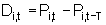 is the absolute change in value of the ith risk factor,
You can use the statistics calculator to calculate the necessary statistical parameters using the classical standard deviation and correlation coefficient methods.
The statistics calculator uses the following formulas:
 is the change in the rate/price (absolute/relative/logarithmed) of the ith risk factor at time
t.
is the change in the rate/price (absolute/relative/logarithmed) of the ith risk factor at time
t.
 is the change in the rate/price (absolute/relative/logarithmed) of the jth risk factor at time
t.
is the change in the rate/price (absolute/relative/logarithmed) of the jth risk factor at time
t.
The formula for the classical standard deviation of the ith risk factor is:

The formula for the classical correlation between the ith risk factor and the j th risk factor is:

This is the basis for calculating the correlation coefficient
 with
with 
 is the logarithmed value change in the ith risk factor, for the day
t, whereby t-T is T days older than t.
is the logarithmed value change in the ith risk factor, for the day
t, whereby t-T is T days older than t.