 Risk Hierarchy
Risk Hierarchy
The market risk of a company or credit institute is the result of a combination of risk factors. For example, interest changes, exchange rate or stock price fluctuations can all affect the value of a company’s financial assets. Market risk represents potential loss(es) due to market price changes. It can thus be used as a key figure in making decisions about equity capital adequacy, the limiting of positions, or the desired minimum yield of a portfolio.
Definition
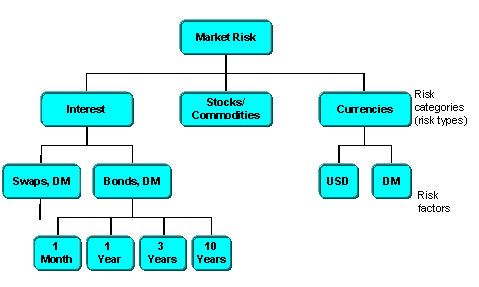
For more extensive control, you need to split market risk into its component factors. Market risk is broken down into the following risk categories:
Each risk category can then be divided into further sub-risks. In the interest area, for example, there are swaps, bonds and debentures, money market transactions, etc. For these sub-markets, there are corresponding sub-risks. These sub-markets are usually different for each currency area.
In the risk hierarchy you define the break-down of market risk into its components. The risk factors provide the basis for the risk hierarchy. By definition, a risk factor cannot be broken down into further components. The risk factors also represent the price-determining elements for the instruments in the portfolio.
In the interest area, key rates are defined as risk factors. The idea with key rates is to define the progress of the yield curve over time using the interest rates for several terms, whereby the key rates are modeled as zero coupon rates. The interest rates for remaining terms are directly determined from the key rates. Since the key rates are implicitly selected when the interest structure is selected, it is not necessary to explicitly define the interest structure in the risk hierarchy. This only occurs in cases where an evaluation is desired for the key rates defined in the risk hierarchy.
In the case of stocks, the stock price is shown in a market index. The assumption with this is that the price development of the stock is directly dependent on the market index.
Use
Risk hierarchies make possible a detailed representation of the influence of different risk factors when valuing. The risks defined in the risk hierarchy are revealed in evaluations.
Structure
Each level in the risk hierarchy is described as a consolidation level. The market risk is the consolidation level at the very top of the risk hierarchy.
The risk hierarchy is constructed starting with the market risk and moving down to the individual risk factors. Its composition is determined by the user via a structure.
At the higher levels, risks are divided into risk categories. Aggregation of risks, starting from risk factors all the way up to the market risk, is usually not additive, as risks actually influence each other. An additive linking of individual risk factors is thus merely an assumption to make it easier to examine the isolated influences of risk factors. In the R/3 system, you have the following aggregation types for each consolidation level:
Risk on a hierarchy level is calculated as the sum of the risks from the lower risk hierarchy levels.
Risk on a hierarchy level is calculated as the sum of the absolute risks from the lower risk hierarchy levels. By using absolute amounts, you create a worst case.
On a risk hierarchy level, risks for all lower risk hierarchy levels are separated according to positive and negative amounts and added together. The larger of the two values represents the value at risk as a positive value.
Risk on a particular risk hierarchy level comes from the risks at all lower risk hierarchy levels, taking into account how they influence on one another (correlation).