
Reorganization Type
There are several types of database reorganization. Select the correct reorganization type - for example, if a specific table is causing space problems, reorganize only that table, and not the entire tablespace.
The following figure shows the different reorganization types. It is based on a tablespace consisting of three data files with two fragmented tables and a fragmented freespace.
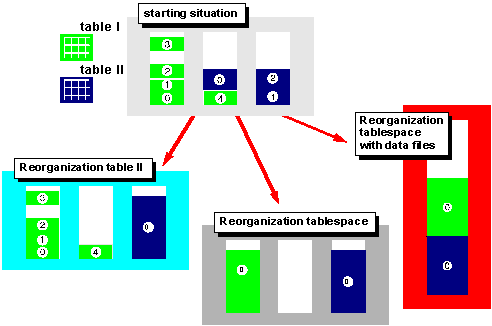
This type of reorganization merges the extents occupied by the table or the index to one extent (using the default value compress extents: yes). In addition, adjacent free storage fragments in the entire tablespace are merged to form one closed area. The Oracle database system does this with its own system monitor.
Depending on the tablespace fragmentation, a table/index reorganization with the option Compress extents: yes may not be possible, even though the total freespace is larger than the table or the index. SAPDBA can detect and display this situation.
See
Reorganization of a Single Object.Each object listed in the list file is reorganized as described in Table/index reorganization.
See
See

The old data files (5 files) have a total of 4.8 GB. SAPDBA recommends creating three new data files with 1.6 GB each. You can also change this default value, for example to 2x1.9 GB and 1x1.0 GB or 4x1.2 GB etc.
This reorganization type is the most complicated, and should only be performed rarely - if at all.
See
See
Defragmentation
SAPDBA always performs a defragmentation of the entire database, regardless of the type of reorganization. Once all the tables and indexes to be reorganized have been deleted, the freespace now existing for the entire database is defragmented. Free fragments which are physically directly next to each other are combined within all the data files. The deleted tables and indexes are then recovered.