 Route String Entry for SAProuter
Route String Entry for SAProuter
Purpose
A route string describes a connection required between two hosts using one or more SAProuters. Each of these SAProuters then checks its
Route Permission Table to see whether the connection between its predecessor and successor is allowed, and if it is, sets it up.Process Flow
The entry of route strings is best illustrated by an example.

The following graphic shows an example of a connection between SAP and a customer system. In this example, an SAP employee working on
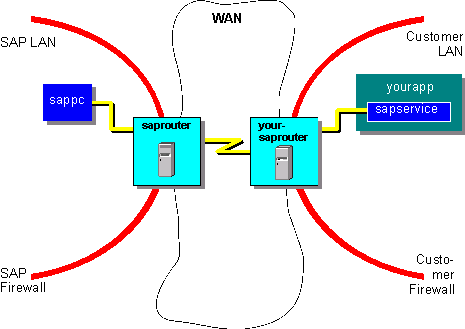
The SAP service employee logs on to the R/3 System and sets up a connection between
sappc and yourapp using the SAProuter on saprouter and the customer’s SAProuter yoursaprouter .yoursaprouter
requires the password pass_to_app for connections with yourapp .The route string appears as follows:
/H/saprouter/H/yoursaprouter/W/pass_to_app/H/yourapp/S/sapservice
This route string is interpreted by the SAProuters involved in the route as follows:
|
Host/Address |
Service/Port |
Password | |
Substring 1 |
/H/saprouter |
/S/<default> |
<no password> |
Substring 2 |
/H/yoursaprouter |
/S/<default> |
/W/pass_to_app |
Substring 3 |
/H/yourapp |
/S/sapservice |
The connection from
sappc to the application server is set up in the following steps:sappc (frontend) |
Sets up the connection to SAProuter saprouter according to substring 1 and relays the route information. |
saprouter (SAProuter) |
Uses the Route Permission Table to check whether the route " sappc to yoursaprouter 3299 " is allowed, sets up the connection to the SAProuter on yoursaprouter , and passes substring 2 and 3. |
yoursaprouter (SAProuter) |
Checks whether the route " saprouter to yourapp, sapservice " is allowed. The password pass_to_app is also checked. SAProuter then sets up the connection to the application server. |
A SAProuter always checks only the previous host name or the previous IP address and the next substring (
/H/.../S/.../W/... ) for host name or IP address, service and password. The last substring does not contain a password, since there is no successor in the route.If the
/S/ section is missing, the default port number of the SAProuter is used. If the /W/ section is missing, a password is not used.
With the old password entry, the above route string would appear as follows:
/H/saprouter/H/yoursaprouter/H/yourapp/S/sapservice/P/pass_to_app
See also:
Route Strings Route Permission Table