Updating of Change Pointers and Document Indices
Updating of Change Pointers and Document Indices
The source data for adjusting documents after conditions change is based on change pointers and
, in certain applications , also on document indices for the documents created.Change Pointers
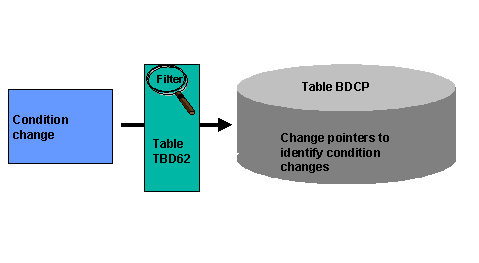
When you change and save conditions, the system updates specific change pointers that characterize the type of change in database table BDCP. In addition to technical data, this table also contains the user name of the person making the change and the time at which the change was made.

As far as the updating of change pointers is concerned, there is no difference between conditions that are created new and existing conditions that are changed.
The following settings must be before
made before change pointers can be updated:In the standard configuration of SAP Retail, table TBD62 already contains all entries about the types of condition changes required for document adjustment. You therefore do not need to change this table usually. You can maintain this setting in Customizing for the relevant application.
Document Indices
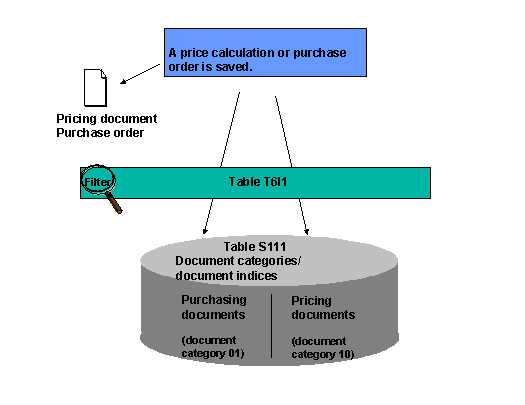
In addition to change pointers, document indices are also important for the adjustment of documents in the purchase order and pricing areas. When application documents are saved, the document indices are updated in table S111 in line with the Customizing settings for the relevant application.
Table S111 is used for Subsequent Settlement. Entries for this application area all have the letter E in field S111-KVEWE.
The document indices contain information on the conditions on which the document is based. The system uses this information to find the documents affected by the condition changes. Document indices therefore form the link between the documents and the conditions on which they are based.
Purchase orders and sales price calculations can be based on a
huge number of conditions of different types. It does not always make sense to have the system analyze condition changes for all condition types. There are two reasons for this. Firstly, the process involved in adjusting the documents is a highly complex one. If all condition types were to be included in the analysis, this would slow down the performance of the programs considerably. Secondly, from a business point of view it is not always necessary or desirable to include all changes, as some condition types do not have any particular effect on prices or would lead to documents being adjusted too frequently.In Customizing for these two applications, you can specify which condition types are to be included in the analysis (table T6I1). For every condition type, you also have to specify the required condition tables and condition origin. Document indices are only created for the condition types specified.
A distinction is made between the two application areas both in Customizing table T6I1 and in the document indices (table S111) via the document category.
Document |
Document category |
Purchasing documents |
01 |
Pricing documents |
10 |
For further information on table T6I1, see also:
Worklist Generation.