 Calculating Material-Based Key Figures (S021, S023)
Calculating Material-Based Key Figures (S021, S023)
The following topic describes how the Shop Floor Information System calculates the key figures used in material-based analyses (production order analysis, material analysis). The key figures are taken from the information structures S021 (Production order) and S023 (Material).
The majority of the key figures in the Shop Floor Information System are average values.
In a material-based analysis, the objects are classified in a period according to delivery date. If a goods receipt has not been posted or if a final completion confirmation has been entered, the delivery date is automatically set to '00000000'. It is therefore possible to include these types of orders in the production order analysis.
Lead Time
The lead time for an order begins with the start date and finishes with the delivery date.
The planned lead time is the difference in factory calendar days between the start and finish dates. The start and delivery dates are included in this time.
The following diagram demonstrates how weekdays are converted into factory calendar days. The planned lead time is calculated as 7 factory calendar days.
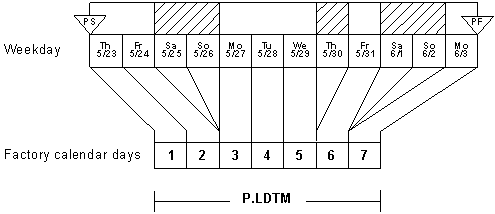

A production order analysis (S021) includes orders that do not have a goods receipt posting, but have the status "Completely confirmed". The final confirmation date of the last operation is used as the delivery date.
Lead Time Deviation
Lead time deviation is the average value of the differences between, for example, planned lead time and actual lead time.
Planned/actual lead time deviation = Planned lead time - Actual lead time
A negative lead time deviation indicates that the actual process took longer than expected, while a positive lead time deviation indicates that the actual lead time was shorter than the planned lead time.
Execution Time
The execution time of an operation is calculated by adding together the setup time, processing time, and teardown time and then dividing the total by the operating time of the work center. The execution time of the production order is calculated by totaling the execution times of all operations.
Queue Time
The queue time is the difference between the lead time and the execution time. Any other times in the lead time that are not classed as execution time are called queue time.
Queue Time Deviation
The queue time deviation is the difference between the target queue time and the actual queue time.
Queue time deviation = Target queue time - Actual queue time
Schedule Deviation
The schedule deviation analysis compares the dates from basic date planning, lead time scheduling, and goods receipt posting. A comparison is made for release dates, start dates, and delivery dates.
For example, the planned/actual start date deviation is the average value of the differences between the start dates in the planned orders and the actual start dates.
Quantities and Scrap
In a production order, a distinction is made between quantities and scrap from the planned order, the production order, and the goods receipt posting. A quantity deviation analysis compares these quantities. The key figures for quantity deviations, quantities, and scrap are all average values.
In the case of production orders that are created without a planned order, the planned quantity is the same as the quantity in the production order.
Capacity Requirements
The key figure "Capacity requirements" is calculated from the total capacity requirements of all operations for setup, processing, and teardown for capacities that are used as the basis for scheduling.