 Example: Regular and Irregular Planning Hierarchies
Example: Regular and Irregular Planning Hierarchies
Your scenario contains two planning steps. Assign plan characteristics (planning levels) to your planning steps as follows:
Planning Step 1 |
Planning Step 2 |
Season |
Season |
Purchasing organization |
Sales organization |
Sales organization |
Merchandise category |
Merchandise category |
Article |
Color |
Activate your planning scenario. You receive an error message because your planning hierarchy is irregular.
Reason: the sequence of the planning levels is not clear enough in the individual steps. In planning step 2, the sales organization comes after the season. In planning step 1, however, the purchasing organization is between the season and the sales organization. The system does not know how to distribute disaggregated planning data entered at season level to the Sales organization level. A network graphic can be used to show the planning level sequence in your hierarchy. Graphic 1 illustrates the example above:
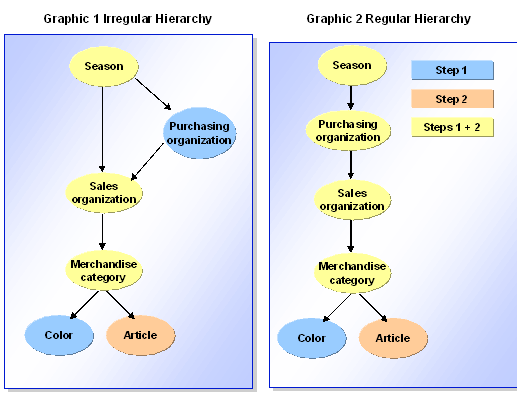
You can see that there are two methods of going from Season to Sales organization. You can remove this problem by integrating plan characteristic 'Purchasing organization' in planning step 1. This does not mean that you must use this plan characteristic as a planning level when planning for planning step 2. You do not have to include it when creating a planning layout. Graphic 2 illustrates an improved sequence of plan characteristics for your scenario.
You can normally use the following rule when creating a planning hierarchy:
The sequence of plan characteristics in your planning scenario must form a tree structure: each characteristic is preceded by one characteristic only.

Additional levels used in planning steps to regulate planning hierarchies can also be selection key figures for the database table assigned to this planning step. This is always possible if you can clearly assign existing plan characteristics to the additional level and if additional planning is not planned in this planning step. Selection key figures are used to optimize the usage of limited info structure key fields.