 OTB: Three Phases of Operation
 OTB: Three Phases of Operation
The open-to-buy functionality can be split into three phases:
·
Planning phase·
Purchasing phase·
Business phasePlanning Phase
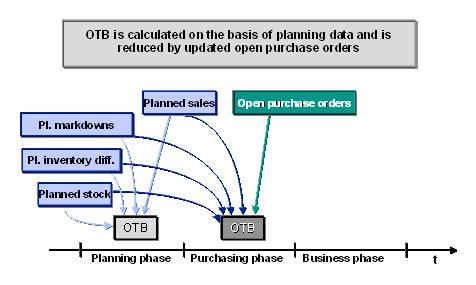
During the planning phase of OTB, you enter the monthly planned sales volume, closing stock, markdowns, and inventory differences. Based on this data, the system calculates the budget for the season and the purchasing budget to be released for each month.
If stock needs to be built up prior to the start of the actual selling period, then the planning period should also include some months prior to the start of the season. For these periods, you only plan the key figure "Stock."

Purchasing Phase
Long before the start of the actual planning period, you can enter purchase orders that have a delivery date that falls during the planning period. That portion of the budget which is already released is available to cover these purchase orders.
All purchase orders reduce the open-to-buy, so that it always corresponds to the portion of the released budget which has not yet been spent.
Business Phase
In this phase, the system compares the planned values for sales volume, stock, and so on, against the actual values. This is to prevent large discrepancies between planned and actual values before they occur. The goal is always to achieve the planned closing stock for the current period, so that discrepancies between planned and actual values do not affect the following periods.
If, for example, a higher sales volume was achieved in May than originally planned, then the closing stock for the beginning of June would be less than anticipated. In this case, additional purchases must be made in order to achieve the desired closing stock.
If, on the other hand, the planned sales volume is not reached, you need to block further buying and stockpiling, and, if necessary, reduce the existing stock by creating a sales promotion or an inventory clearance.
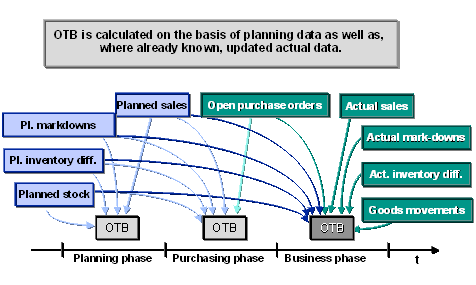
The following are taken into account in calculating OTB:
·
If the total quantity of goods actually received deviates from the total quantity contained in the purchase orders creating during the purchasing phase, then the OTB will be adjusted by the difference between these amounts.·
If the time of goods receipt deviates from the planned delivery date so that the two dates fall in different periods, then the quantity of goods received needs to be moved into the proper period. As a result, only the outstanding purchase orders are taken into account for the delivery date, while goods receipts are included in the OTB calculation for the posting date.If goods receipt occurs earlier than planned, then part of the OTB becomes available in the planned period and the goods receipt period is debited.
If goods receipt occurs later than planned, then OTB becomes available in the planned delivery period, which has already passed. This is not transferred into the subsequent period because the amount has already been cleared by the lower opening stock at the start of the subsequent period (caused by the missed delivery).
·
Whether and by what amount the actual sales volume deviates from the planned sales volume during the current period, can only be determined at the end of the period. For this reason, the sales volume at the end of the period is extrapolated for the OTB calculation of the current period. (The sales volume extrapolation is carried out linearly to the end of the month. A user exit is provided, should you wish to define a different calculation for this extrapolation.) Also, the differences between the planned and actual values caused by the change in opening stock take effect, at the latest, in the subsequent period.·
Markdowns and inventory differences:If actual markdowns and inventory differences exceed plan, the differences are taken into account in the OTB calculation in the current period.
If actual markdowns and inventory differences are less than planned. then the resulting differences in the planned and actual values only become effective in the subsequent period, in the form of higher opening stock.
·
All actual goods movements that were not planned and were therefore not included in the budget calculation (for example, inventory clearances) affect OTB in the current period. For example, if merchandise is transferred to another store, then the OTB in the issuing store is increased so that the stock that is now lacking can be replaced.With the above considerations, the unused OTB of completed periods is transferred to periods as far in the future as possible to prevent the planned and actual amounts from drifting apart over several periods.
