Requirements Planning: Determination of Requirements (Pull)
Requirements Planning: Determination of Requirements (Pull)
Use
‘Pull’ Method of Distribution in the Strict Sense
In the strict sense, a ‘pull’ method of distribution is one in which you react directly to consumer requirements over several steps in the supply chain.
In SAP Retail, you could pull merchandise back through the supply chain as follows:
For requirements planning in the store, you use Replenishment, which is able to analyze sales immediately in POS inbound processing. In Replenishment, warehouse orders are then created as follow-on documents. Order quantities are not optimized, to ensure that requirement quantities are transferred unchanged, in line with the classic pull method.
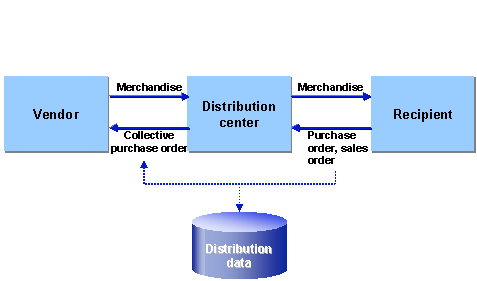
In the distribution center, the warehouse orders created in Replenishment are grouped together to create a collective purchase order for the vendor. As a result, consumer sales figures are passed on directly to the vendor.
‘Pull’ Method of Distribution in the Wider Sense
In the rest of this section, however, the ‘pull’ concept is enlarged to cover all requirements-driven planning transactions. This therefore includes transactions that only comprise one step in the supply chain, for example, and those in which consumer requirements are forecast on the basis of historical consumption data.
Features
Replenishment
Replenishment is a method of requirements planning designed especially for use in stores. Technically speaking, it can also be used in distribution centers.
Replenishments planning is based on the article stock, which is managed either by MM Inventory Management or simplified Inventory Management for Replenishment. Stock levels are reduced as a result of article sales, which are registered as goods issues in POS inbound processing. Depending on the method used, all other goods movements may be included in this stock. In replenishments planning, follow-on documents are created for procurement and delivery.
For further information, see
Replenishment.Collective Purchase Orders
Collective purchase orders are used to plan merchandise distributions. The merchandise is ordered from a vendor and delivered to a distribution center, where it is distributed to the individual recipients. You can use a collective purchase order to combine the requirements of recipients, which may exist in the system as warehouse orders or sales orders, to create a single order for a vendor.
Distribution data for a collective purchase order is kept in the system and you can then use this to control and monitor the distribution of merchandise to recipients. This data is accessed for cross-docking and flow-through, for example. In addition, a collective purchase order allows you to make better use of vendor conditions, such as quantity discounts.
For further information, see
Collective Purchase Order.Consumption-Based Planning
Consumption-based planning is particularly suited for use in distribution centers. However, it can also be used for stores. Inventory management on a quantity and value basis is a prerequisite for this planning method. As a result of planning, purchase requisitions are created, and these are then automatically converted to purchase orders. Consumption-based planning also enables you to carry out time-phased planning.
For further information, see MM - Materials Management,
 MM - Consumption-Based Planning.
Online Planning
Online Planning enables you to plan online the procurement of merchandise from external vendors. Online Planning is designed for use in distribution centers. It can, however, be used in stores (to order from external vendors). It enables you to check and change existing purchase orders (to meet minimum order criteria, for example). You can also create new purchase orders.
Online Planning can be based on the results of automatic requirements planning. This option is only available, however, if purchase orders already exist, that is if purchase requisitions have already been converted to purchase orders (see
Reference Scenario).For further information, see also
Online Planning.Immediate Manual Planning (Planning Requirements for Perishables)
This procedure was designed for requirements planning for fresh produce, and is therefore referred to as requirements planning for perishables in SAP Retail. The functions for requirements planning for perishables can also be used for non-perishable articles that nonetheless make similar demands on the system.
For further information, see
Perishables.Vendor-Managed Inventory (VMI)
In SAP Retail, vendors can carry out requirements planning as a service to their customers. In line with your efforts to achieve efficient consumer response, this enables you to work closely together with vendors/manufacturers as "allies" in the supply chain. This gives you the opportunity to improve your vendor service level and at the same time reduce stock on-hand.
For further information, see
Vendor-Managed Inventory.