RFC Ports


RFC Ports
The CSL tokens are moved if necessary when
CSLEO_ENQUEUE is called. For this reason, the token managers in the linked systems have to communicate with each other by using an RFC. There are two database tables for setting up the communication channels between the systems:As far as the CSL is concerned, a physical communication partner is a direct communication partner that can be reached by a point-to-point connection. A logical communication partner, on the other hand, can also be reached by third-party systems.
Determining the RFC Port
For a Remote Function Call (RFC or tRFC) from a sender token manager S = {SYS, NUS} to a recipient token manager R = {SYR, NUR}, the CSL proceeds as follows:
The entries in the
CSL_CCP table therefore override the general RFC settings for any communication between the token manager and other systems. This table contains the following fields:|
Field Name |
Meaning |
Example |
|
CIRSY |
Logical system of the token manager where the communication starts (Communication Indicator System) |
RAMCLNT004 |
|
CIRNU |
Number of the token manager from CIRSY |
01 |
|
CPPSY |
Physical communication partner of the token manager that is specified by CIRSY and CIRNU (Communication Partner Physical) |
ROMCLNT001 |
|
CPPNU |
Number of the token manager from CPPSY |
01 |
|
PO |
RFC inbox (target port) of the token manager that is specified by CPPSY and CPPNU This port must be entered in the RFCDES table in the outbound system. This table can be processed in transaction SM59 only (see: Maintaining Remote Destinations). Maintaining Remote Destinations). |
ROM_PORT |
Routing
Since an RFC connection between two systems is not always needed, we cannot assume that an RFC connection is set up between all linked systems. You can define a routing that is connected by an RFC to the other two systems by using a third-party system.
The routing is not described centrally. Instead, you specify for each token manager which is the nearest physical communication partner for reaching the logical communication partner. A row in the
CSL_CCL database table contains such a reference:|
Field Name |
Meaning |
Example |
|
CIRSY |
Logical system of the token manager where the communication starts (Communication Indicator System) |
FROCLNT000 |
|
CIRNU |
Number of the token manager from CIRSY |
01 |
|
CPPSY |
Physical communication partner of the token manager that is specified by CIRSY and CIRNU. This is a token manager that the CSL can use to reach the logical communication partner |
NXTCLNT002 |
|
CPPNU |
Number of the token manager from CPPSY |
01 |
|
CPLSY |
Logical communication partner – the token manager that has to be reached at the end |
FARCLNT001 |
|
CPLNU |
Number of the token manager from CPPSY |
01 |
|
LEM |
Specifies the number of systems that can be used to reach the logical communication partner, minus 1. This is a typical routing parameter for selecting the shortest possible route. |
2 |

The routing that is defined by a row in the
CSL_CCL table is one-way.Example
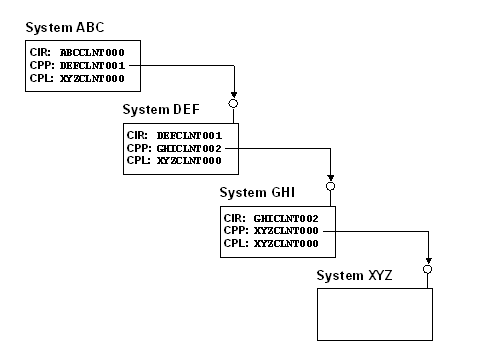
There is no RFC connection between systems ABC and XYZ. As shown below, you can use the entries in the
CSL_CCL table to define a routing using systems DEF and GHI.
To simplify the graphic, we have abbreviated the field names and omitted the numbers of the token managers.
If the token manager in the
ABCCLNT000 system wants to communicate with the token manager in the XYZCLNT000 system, the CSL looks in the table for the corresponding entry with the correct outbound system (CIRSY field) and the correct logical target system (CPLSY field). The CSL uses the nearest physical communication partner (entry in the CPPSY field) to track the route to the target system. In this case, the LEM field would have the value 3 in the ABC system, 2 in the DEF system, and 1 in the XYZ system.
The CSL must be activated in all the linked systems for the routing to work.