
 Forecast Model

Definition
The forecast model controls the level at which the forecast is to be carried out and which influencing factors are to be taken into account in what way.
Use
The forecast model is the central object in the aggregated long-term forecast.
It is based on the following model formula:
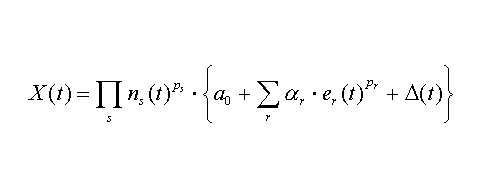
Key:
X (t): Value of the forecast key figure in period t
ns (t): Value of the normalizing influencing factor s in period t
re (t):Value of the explanatory influencing factor r in period t
alpha 0: Constants
alpha r: Weight of the explanatory influencing factor r
Ps or Pr: Exponent belonging to influencing factor r or s (can be freely defined)
delta (t): Non-explicable element in period t
You can adjust the above formula in the definition of the forecast model to suit your requirements.
In particular, the following choices are available:
· Choice of the key figure to be forecast
· Choice of the level on which the forecast is to be performed, including periodicity
· Choice of the normalizing influencing factors
· Choice of the explanatory influencing factors
· You can choose the exponent p for each normalizing or explanatory influencing factor.
Structure
A forecast model consists of the following components:
· Forecast key figure
· Periodicity
The following periodicities are supported:
¡ Week
¡ Month
¡ Posting period
If you choose the periodicity ‘posting period’, you must enter the fiscal year variant in the definition of the forecast model.

Only periods with a maximum of 96 days are supported.
· Forecast level
· This is in the form of a list of characteristic InfoObjects.
· Additional data for the influencing factors assigned to the forecast model
¡ The mode of action within the forecast model
¡ The exponent to be used for the power of the values of the influencing factors.
· The mode of action describes the position of the influencing factor in the formula above.
You define the mode of action in Customizing for the forecast model for each influencing factor.
The system supports the following modes of action:
· Explanatory (corresponds to the er in the above formula): The values of the influencing factor (weighted by the regression coefficients) contribute to the values of the forecast key figure in an additive way.
· Normalizing (corresponds to ns in the formula above): The values of the forecast key figure are proportional to the values of the influencing factor.
· Influencing factor with the mode of action ‘number of sales days'
If you do not use this influencing factor, all days in the period are sales days. Division by the number of sales days does not take place.
If you do use this influencing factor, it has the following consequence:
¡ The influencing factor acts as a normalizing factor within the forecast model.
¡ The determination of all calendrical influencing factors assigned to the forecast model changes as follows:
§ Only the days on which the influencing factor is active and which are also sales days are taken into account.
§ The number of days determined is divided by the number of sales days in the period.
The following table shows the modes of action that are permitted for each influencing factor type:
Influencing Factor Type |
Additive Effect |
Normalizing Effect |
Number of Sales Days |
BW-BPS key figure |
x |
x |
|
Event |
x |
|
|
Number of sales days |
|
|
x |
Exit |
x |
x |
x |
¡ Influencing factor type number of sales days:
§ You use this influencing factor type a maximum of once for each forecast model.
§ You cannot define exponents for this influencing factor type.
¡ The characteristics in the forecast level must form a superset for the set of characteristics in the definition levels of all the influencing factors assigned to the forecast model.
For more information about the forecast model, see the Implementation Guide (IMG), under:
SAP NetWeaver à Business Intelligence à Settings for BI Content à Retail à Aggregated Long-Term Forecast à Define Forecast Model.
Integration
The forecast model accesses the following objects:
· Assigned influencing factors to supply the forecast with external influences (ns or er in the above formula).
The forecast model is used by:
· Analysis process for model training: the definition of the analysis process is evaluated during consistency checks.
· Function for adding and removing the explicable element within the forecast process.
Example
SAP provides the following forecast model: 0RME_FC1 (Example forecast model).
This forecast model is not released for productive use.
See also:
Influencing Factor Type Number of Sales Days