Healthcare Reporting Generic
Purpose
Countries for which there is no country-specific Healthcare content can use the general content. The generic part of the content also represents the basis for forming a country-specific patient classification system.
This documentation covers possible questions that are of general interest in hospitals and, as such, are valid for all countries.
What is the trend in referring facility behavior? (for example, overview of referring physicians)
Which services have we performed? (for example, Case-Related Services query)
Which diagnoses were made and which procedures performed? (for example, Diagnosis Overview and Procedure Overview queries)
Which costs are generated by the various cost centers? (for example, Cost Center/Cost Element Overview query)
Which costs were generated atcost object (case) level? (for example Case-Related Costs on Basis of Case-Based Orders)
The data view is dependent on the recipient of the information. The Healthcare content supports the Generic Healthcare Role ( SAP_BW_HC_GEN ) for this.
Implementation Considerations
To be able to use the Healthcare Business Content, you have to activate the delivered objects. You’ll find information on how to do this in the documentation for the SAP Business Information Warehouse under

Administrator Workbench

Business Content (Versions)
 .
.
To make this simpler, you can activate the cross-country content from a generic role.The system takes into account the necessary general and generic content in accordance with the reports that are assigned to the role.
 Caution
The master data InfoProvider Case is the leading object and, as such, has many navigation attributes. Check which attributes you use in the queries. For performance reasons, you should deactivate the navigation attributes that are not necessary in the various InfoCubes and in the case.
Integration
OLTP Release |
SAP Patient Management 4.72 |
|---|---|
SAP BW Release |
BI Content 3.5.2 Add-On |
Features
Data Flow for InfoProvider Case
The InfoProvider
Case
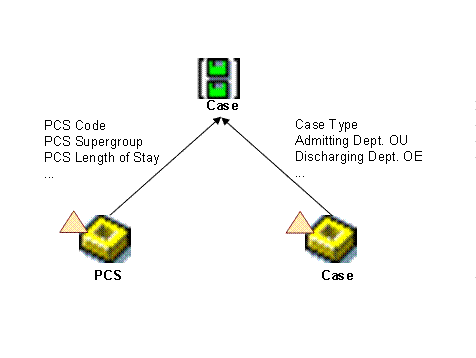
is filled for a country without a specific instance of the patient classification system (PCS) from the master data InfoSource of the InfoObject
Case
. The case get the PCS-relevant attributes and other attributes, such as the hospital main diagnosis, from the generic InfoSource of the transaction data of the PCS.
The following graphic depicts the data flow for the InfoProvider
Case
:
Data Flow for Movements, Occupancy
The cross-country InfoCubes
Movements
and
Occupancy
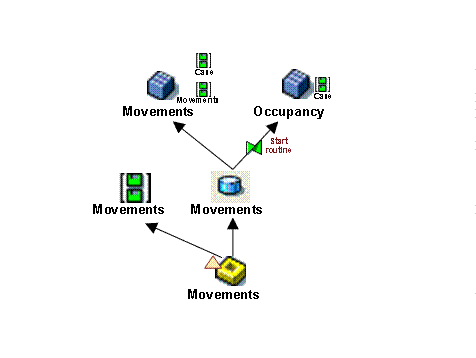
are filled from an InfoSource. For the
Occupancy
InfoCube, the system distributes the day key figures specified in the extracted records in the start routine to all calendar days (midnight patient census) and copies the characteristics. The system uses the upload date to delimit movements that do not have an end date, and provides them again each time the data is loaded to complete the information for the missing calendar days.
To create capacity utilization analyses, you have to fill the InfoCube Beds (see Healthcare Reporting Germany or Healthcare Reporting Austria) country-specifically and link it with the
Occupancy
InfoCube to form a MultiCube.
The following graphic depicts the data flow for movements, occupancy:
Data Flow for Services
The
Services
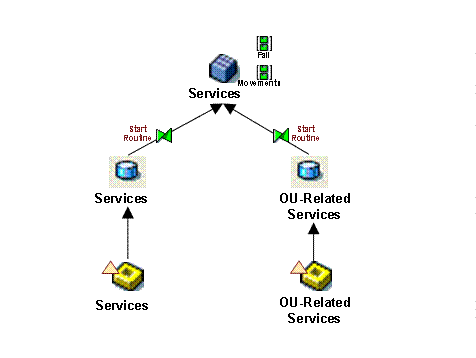
InfoCube is filled from two InfoSources. Depending on whether case-related and/or OU-related services exist in SAP Patient Management, you can discount one of the branches.
The system distributes the quantities and values of the case-related and OU-related extended services to the calendar days according to the valuation formula and copies the characteristics. The system uses the upload date to delimit services that do not have an end date (for example, extended services of discharged cases), and provides them again each time the data is loaded to complete the information for the missing calendar days.
The following graphic depicts the data flow for services:
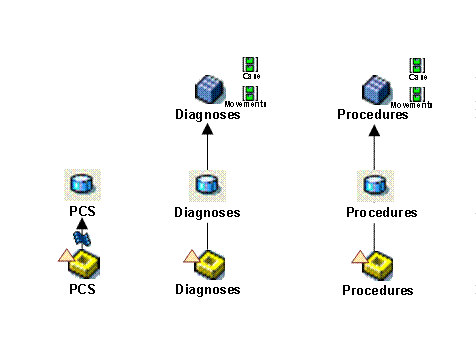
Data Flow for PCS, Diagnoses and Procedures
The generic InfoSource
PCS
fills the generic ODS object
PCS
that you can use as a basis for the specific instance of your country-specific patient classification system (PCS). We provide a query on the ODS
PCS
as an example.
For a country-specific representation of the patient classification system you have to fill the ODS
PCS
with the PCS data of your country and construct a new InfoCube based on the ODS
PCS
.
The InfoCubes
Diagnoses
and
Procedures
are filled by cross-country InfoSources.
The following graphic depicts the data flow for PCS, Diagnoses and Procedures:
Data Flow for Controlling Information
The InfoCubes
Case-Related Costs
and
OU-Related Costs
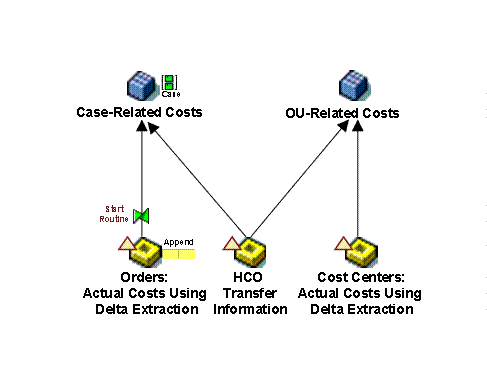
are filled using a Controlling InfoSource. You also get information from SAP Patient Management’s CO transfer module.
For a country-specific representation of the case costs taking into account the patient classification system used in your country, you have to fill the ODS with the PCS data of your country, construct a new InfoCube based on the
PCS
ODS and link this to the
Case-Related Costs
InfoCube to form a MultiCube.
The following graphic depicts the data flow for Controlling information: