 Tabulation

Tabulation
Use
You have to assign tables to your LOIO, PHIO, and relationship classes, so that the instance data can be stored in the runtime system. You can also store attributes in the header data of a logical or physical info object, in order to improve performance. This procedure is called tabulation. Both virtual and real classes can be tabulated. We recommend that you tabulate the attributes that are most frequently used to select info objects.
The tabulation of a virtual class is only a template and is thus transferred into a replicated class.
Relationship class can be tabulated only for relationships that are defined as an Independent link.
Scope of Functions
The number of attributes that can be entered in the table fields of the header data for info objects is set to a maximum of 10. The field lengths for these attributes are also restricted:
Four attributes have a field length of 15 characters
Three attributes have a field length of 20 characters
Three attributes have a field length of 40 characters
Attributes whose field length is greater than 40 characters have to be saved in a separate attributes table.
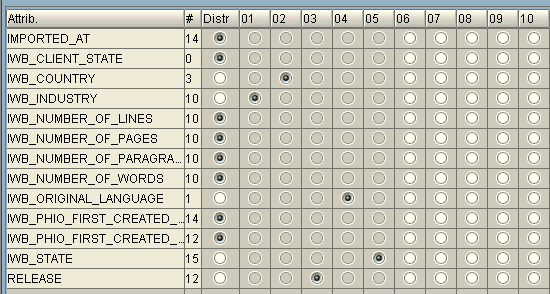
Example of tabulation of attributes
This attributes table contains all attributes that are not already contained in the header data (such as CREATED_AT). These can be attributes that are not assigned to any of the ten fields due to their length. The actual data length is displayed in the column "#". If this column contains a 0 for any attribute, this means that the attribute has not been correctly typed. In such a case, it is up to you whether you enter this attribute and in which header line field.

We recommend that you maintain an ABAP dictionary reference for each attribute. This helps avoid inconsistencies and also allows the system to make input checks.
Activity
There are a number of ways of carrying out a tabulation:
 (Start tabulation editor) in the right-hand part of the screen.
 (Tabulation).