
 Data Transfer from the Application
System
Data Transfer from the Application
System

Purpose
You use this process to:
● Specify the parameter containers for SAP Event Management (SAP EM) in the application system (AS) that it fills with data from the table containers
● Trigger the transfer of parameter containers to SAP EM
●
Obtain an input
help for mapping
 parameters in SAP
EM
parameters in SAP
EM
● Save events that have occurred for business objects in the application system in the relevant event handlers in SAP EM
Prerequisites
You have completed the following on the application side:
● Defined the logical system
● Specified the application objects that are relevant to supply chain event management (SCEM-relevant)
● Specified the Active mode for the business process type for your SCEM-relevant application objects and events
● Assigned function modules to extractors in Customizing for the application system
● Assigned the extractors to application object types and event types in Customizing for the application system
● Specified the corresponding SAP EM(s) for the application system
● The parameters in SAP EM
Process
...
...
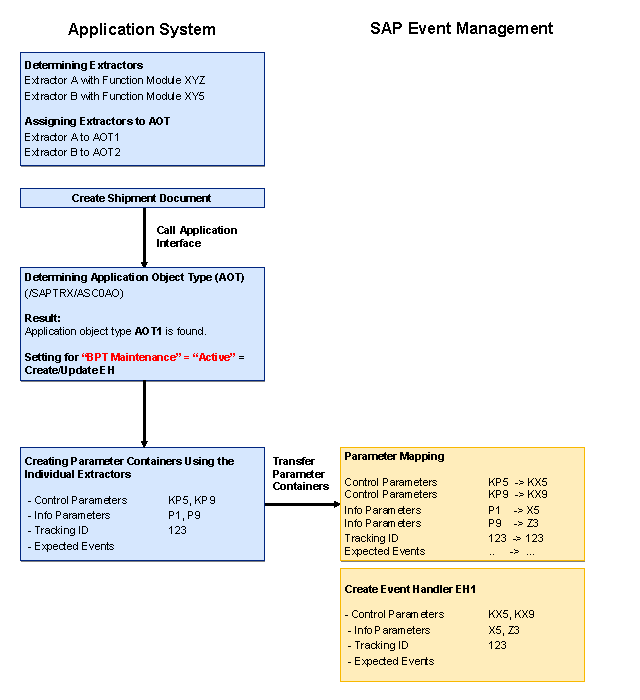
1. The process begins when you create or change a document in the application system.

For example, you have completed the following in Customizing for the application system:
● Specified extractors A and B for creating the info parameter list.
You assign function module XYZ to extractor A and function module XY5 to extractor B.
● Assigned extractor A to application object type AOT1 and extractor B to application object type AOT2
You create an application object AO1 for application object type AOT1
You create an event EV1 for event type EVT1.

As of PI Basis 2006.1, you can define a Customizing for the extractors and work with table-based extraction.
2. The application system determines the application object types. It automatically creates the parameters (parameter list, milestones, query IDs, and tracking IDs) in the individual extractors that are assigned to the application object types. The application system also generates the event data that belongs to this event type.
For example, the system creates an info parameter list with the AS info parameters P1 and P9 for application object AO1. The system also creates the event data for event EV1.
If you have set the mode of the business process type for your SCEM-relevant application objects to Maintenance, the system continues to create an input help for defining parameters.
You use business object keys as a back link from SAP EM to the application system.
A shipment consists of two deliveries and two handling units. It is not sufficient for you to know the main object table with its technical key as a back link to the object in the application system. The back link using the business object key allows you to assign a business object in a unique way.
3. The application system transfers the following data to SAP EM using the definition for parameter mapping and the parameter dictionary that you have defined:
○ The parameter list
○ The milestones
○ The query IDs
○ The tracking IDs
○ The event data
You have specified in Customizing for SAP EM that SAP EM is to perform the following mapping for application system AS1 and application object type AOT1:
● AS info parameter P1 onto SAP EM info parameter X5
● AS info parameter P9 onto SAP EM info parameter X3
4. SAP EM transfers the data to the event handler that belongs to the application object.
For example, the SAP EM info parameters X5 and Z3 and the event EV1 are transferred to event handler EH1.
The following figure provides you with a simplified overview of the standard case for transferring application data from the application system to SAP EM:
Result
The application system has transferred the following data for an application object and event that you have defined as being SCEM-relevant to SAP EM:
● The parameter list
● The milestones
● The query IDs
● The tracking IDs
● The business object keys
At the same time the application system has created an event for this application object and has also transferred this data to SAP EM.
SAP EM has written all the data into the relevant event handler (parameter data in accordance with the relevant definition for parameter mapping).