 Method
Definition
A Customizing tool in consolidation. You use methods to control how the system calculates and posts automatic consolidation entries.
Methods can be based on method layouts (see also Creating a Method with a Step Hierarchy).
Integration
To be able to execute tasks, you assign the methods to the corresponding tasks or consolidation units.
The assignments are always version dependent and time dependent: Version dependency is ensured by means of task versions. There is a separate task version for each task category that requires version-dependent assignments (for example, method, document type). You assign the task version in Customizing of the version.
The following types of method assignments are available:
Assignment of methods to tasks
Assignment of methods to tasks based on the consolidation unit
Assignment of methods to consolidation units and consolidation groups
You assign a method to tasks and consolidation units when a new task is created.
Assignment of Methods to Tasks
You assign methods to tasks for the following task categories:
Balance carryforward
Data collection
Copy task
Currency translation
Validation
Reconciliations
Interunit elimination
Reclassification
Allocation
In addition to the version dependency and time dependency already mentioned, the assignment of methods to tasks is also based on the period category (exception: balance carryforward). This means that you can assign different methods to different period categories in the same task. However, you can only choose from period categories that belong to the same period category group.
 Example
You have defined a period category group that contains the following period categories:
Period Category | Description | Periods |
|---|---|---|
410 | January to November | 1, 2, 3, ... , 11 |
411 | December | 12 |
You could now create the following assignment between methods and period categories:
Period Category | Method |
|---|---|
410 | METH1 |
411 | METH2 |
In Customizing for methods, you can choose freely between the possible period categories. If more than one period category is possible, when the method is created, the system chooses a default period category that best matches the current values of the global parameters. In the example above, the system would propose period category 411, for example, if the period is set to 12 in the global parameters. However, you can also choose a different period category.
Example

Creating a New Interunit Elimination Task: Assignment of Document Type and Method
In the following cases, you assign a method to a task indirectly:
You can assign a copy method to a data collection method and then assign the latter to a data collection task (see also Defining a Copy Method).
You can assign a currency translation method to a copy method and assign the latter in turn to a copy task (see also Consolidation in Multiple Group Currencies).
Assignment of Methods to Tasks Based on the Consolidation Unit
For the following task categories, you can assign the methods to the task based on the consolidation unit:
Validation
Data collection
Special rules apply to data collection. For more information, see Data Collection Method.
Currency translation
Example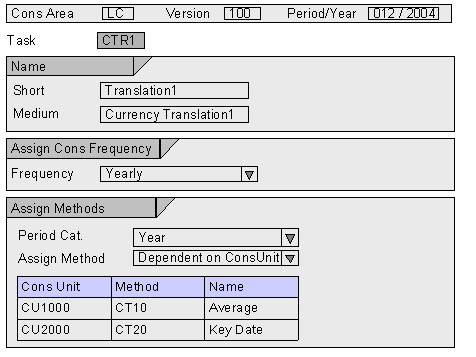
Creating a New Currency Translation Task
End of the example.
When you activate the Financials, Group Close, Allocation (FIN_ACC_GC_ALLOC
) business function and then activate the Method Assignment of Reclassification Tasks
function in the settings for the consolidation area, you can also assign methods for the following task categories based on the consolidation unit:
Reclassification
Allocation
This is only possible, however, if the processing type of the respective task takes place at consolidation unit level (that is, the task posts with a document type at posting level 01 or 10).
If you have activated the Financials, Group Close, Check Digits (FIN_ACC_GC_CHKDGT
) business function, you can specify a default method for each consolidation unit during method assignment. When the task is executed, the system uses the default method specified for all those consolidation units for which you have not entered any explicit settings.
Assignment of Methods to Consolidation Units and Consolidation Groups
This type of assignment applies to the accounting techniques in consolidation of investments and the consolidation of investments methods. For more information, see Assignment of Accounting Techniques and C/I Methods.