Amortization Using the Deferral Item for the Purchase Value (Discounts/Premiums)
Use
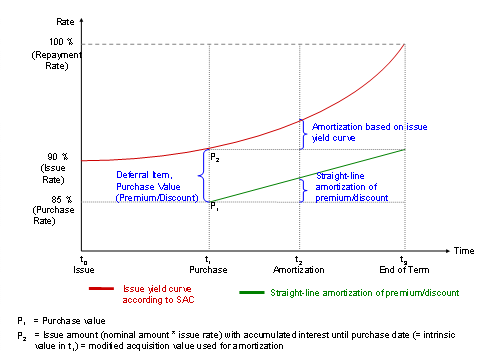
Based on the issue value of a security, a yield curve can be determined from the time of issue to the time of repayment.If a security is purchased during the term, its price is usually above or below this theoretical yield curve.
If you use the
Position Component
Deferral Item for the Purchase Value,
it displays the difference between the actual security purchase value and the value of the security according to the theoretical yield curve. During amortization, the
deferral item for the purchase value
is deducted pro rata over the remaining term
using the straight line method
.
The deferral item is not included in the book value nor taken into account when price/rate gains are calculated.
The
deferral item for the purchase value
is included in the purchase value, which means that standard amortization is based on the modified acquisition value. The
deferral item for the purchase value
is also deferred on a linear basis for amortization purposes.
Deferral Item, Purchase Value
This position component may be positive (deferred income) or negative (deferred expenses).
For the derived business transactions for the position inflows and outflows, and the key date valuation, the system generates corresponding flows.
 Note
Note
The
deferral item for the purchase value
is deferred with the
key date valuation
function and not with the
accrual/deferral
function.
The function can be used in both the gross and net procedures.
Prerequisites
The
Deferral Item for the Purchase Value
function is used for the position management categoriesSecurities/Loans/Money Market Without Index-Linked Bonds (BFT1)
andIndex-Linked Bonds (BFT2)
.Under
Other Components,
in the amortization procedure you need to selectDeferral Item for the Purchase Value
.You make these settings in Customizing for
Treasury and Risk Management
by choosing
Transaction Manager

Accounting
Settings for Position Management
Key Date Valuation
Define Amortization Procedure
 .
.
You need to define, assign, and set up the required update types in the following IMG activities:
Define Update Types and Assign Usages, Assign Update Types for Derived Business Transactions,
andAssign Update Types for Valuation.
Examples
For zero bonds, it is required by law that the purchase value in the financial statement for tax purposes corresponds to the value of the issue yield curve as opposed to the purchase price paid. Zero bonds must therefore be amortized in accordance with the issue yield curve.
The difference in purchase price is managed as an accrued/deferred item and cleared equally over the term to the profit and loss account. The deferrals are cleared on an incremental basis for each position change and key date valuation.
The deferral item is not included in the book value nor taken into account when calculating price/rate gains.
Example 1
The purchase price of a zero bond amounting to 100,000 UNI (nominal amount) at a rate of 60% is 60,000. The current market value on the issue yield curve according to SAC amortization is 70,000.
The book value is 60,000.
The
deferral item for the purchase value
(deferred income) is displayed for the difference in amount of 10,000 on the issue yield curve. This amount is then cleared over the term on a linear basis.If the security is sold at a price of 60,000 directly after it has been purchased, there is a price loss of 10,000. The posting-relevant translation of the deferral item and the offsetting posting (
deferred income
) clear the balance on the profit and loss account.
Example 2