 Settlement of Investment Measures
When you settle capital investment measures, you generally need to settle the costs collected on the investment measure to different receivers. The system carries this process out automatically for the most part, using control parameters and settlement rules you have entered. There are two ways of settling investment measures:
Periodic settlement at the close of the period
Full settlement or partial capitalization of the investment measure at its completion
Features
The following figure provides an overview of the flow of values during the settlement of an investment measure.
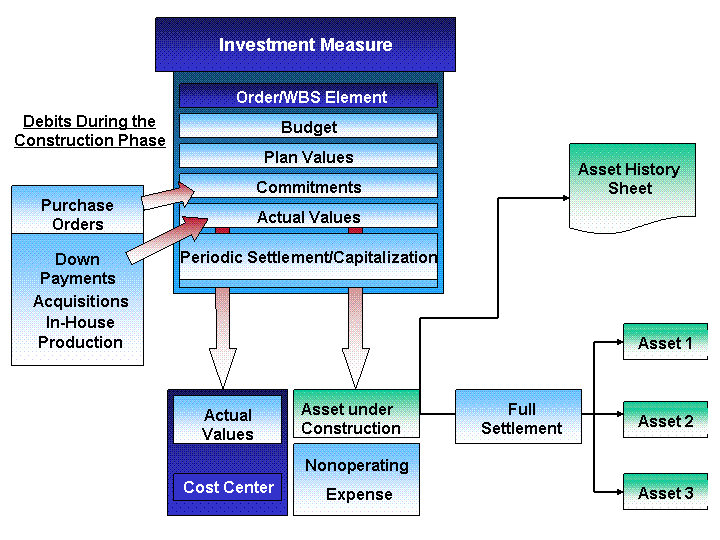
Flow of Values During Settlement
Periodic Settlement
During periodic settlement, the actual costs on the order or WBS element are allocated completely or partially to one or more receivers. At the same time, the system generates automatic offsetting postings that credit the order or WBS element. The original debit postings to the order or WBS element still exist on the receivers after the settlement (and can be displayed). The settled costs are written to the receiver object and shown in reporting.
There are two parts to the periodic settlement:
The settlement to CO receivers (such as, cost center) of debits that do not have to be capitalized
The settlement to the asset under construction belonging to the investment measure of debits requiring capitalization
The settlement to CO receivers involves all complete debits not yet capitalized to an asset under construction. It is therefore possible to post and manage debits to an investment measure for management accounting purposes, even if these debits have no relevance for capitalization in the balance sheet (for example, overhead).
In the same step as the settlement of debits to CO receivers, the system settles to an asset under construction. You can define the settlement to assets under construction for each depreciation area. The function of depreciation areas in Asset Accounting is to calculate values of fixed assets for various business-related and legal purposes (for example book depreciation, tax depreciation, cost-accounting depreciation, and so on). These areas make it possible to take different capitalization rules into account during the settlement to the asset under construction. The system posts costs that do not require capitalization (valuation differences between depreciation areas) to nonoperating expense.
Full Settlement
Full settlement takes place when the investment measure is completed. During the full settlement, the debits that were transferred to the asset under construction are settled to completed assets. If debits were transferred incorrectly to the asset under construction, you can make a correction at this point and make a final settlement of these debits to cost centers. However, this is allowed only for debits that were posted during the current fiscal year. Debits from prior fiscal years are not allowed to be settled to cost centers at this point, since they were already listed under assets under construction in the balance sheet from the previous year.
However, you should note that you can still post acquisitions to the investment measure after the full settlement. There is no change to the status of the investment measure. Therefore, it is possible to have any number of full settlements for the same investment measure.
New Asset Accounting
In new Asset Accounting
(meaning with business function FI-AA, Parallel Valuation
(FIN_AA_PARALLEL_VAL
) and the Customizing switch activated for new Asset Accounting), the depreciation areas are all on equal footing. Depreciation area 01 does not have any priority in the chart of depreciation; there is no master depreciation area.
This has the following results for settlement:
Asset transaction updates are specific to ledger groups. During settlement, therefore, the system creates a separate document for each ledger group that is assigned to a depreciation area in the chart of depreciation.
Settlement is posted in all depreciation areas in real time. Periodic posting of asset balance sheet values is not necessary.
Settlement of costs is posted with the leading depreciation area. The leading depreciation area is the area in the chart of accounts to which the ledger group is assigned that contains the leading ledger in the general ledger. In FI, however, the (nonoperating) expense is updated specific to ledger groups in each ledger group.
More Information
Section... | Contains information about... |
System configuration and settlement parameters for periodic settlement to CO receivers and assets under construction, then settlement of objects subordinate to a measure as well as to | |
Entering settlement rules and distribution rules for line item settlement as well as for | |