 Structure of the Investment Program
Use
The system displays the program structure in maintenance transactions in the form of a horizontal tree diagram. You can assign investment measures and appropriation requests to the investment program positions.
Features
Creating the Program Structure and Program Positions
When you create or change the tree diagram, you can also directly define the corresponding program positions and assign them to the desired position in the hierarchy using fast entry.
The system uniquely identifies each program position based on its:
Investment program name and approval year
Position ID that has a maximum of 24 characters
 Note
Note
The maximum number of hierarchy levels is 99.
There are limitations on how complex the investment program can be, due to performance considerations. Since performance is strongly dependent on your system configuration, we can only offer a figure for orientation: If your investment program has more than 10,000 positions, you should contact your SAP consultant.
You can make organizational assignments for each program position (such as, assignment to a company code, business area, plant, or cost center). When you create new program positions below existing positions in the hierarchy, the system automatically copies the assignments and the general data from the higher-level position to the new lower-level position you are creating.
However, if you later change the organizational assignment of a program position that has subordinate positions in the hierarchy, the system does not automatically copy the changes to these subordinate program positions.
There is a report you can use to check the consistency of the organizational units in investment programs (refer to Inheritance of Organizational Units ).
Top Positions and Controlling Area
You have to assign the top positions of a program to a controlling area. The system then automatically copies this controlling area to all subordinate positions. In this way, it is guaranteed that a subtree of an investment program always belongs to a given controlling area.
Measures
The program positions that do not have any subordinate positions assigned to them in the hierarchy are called end nodes The individual measures of the investment program can be assigned to these end node positions. You can assign internal orders, maintenance orders and WBS elements to investment programs as measures (refer to Connection between Programs and Measures ).
You can make one of the following specifications for an end node position:
The individual measures assigned to the end node can be budgeted separately, and the totals of these budgets are compared with the budget for the program position only on a periodic basis in reports. (The
Budget dist. overall
indicator is not set.)The individual measures assigned to the end node receive their budget directly from the program position. (The
Budget dist. overall
indicator is set.) In this case, the subordinate measures can receive their annual budget, in addition to their overall budget, by direct budget distribution from the program position, if theBudget dist. annl.
(budget distribution of annual values) indicator is set in the program definition. A consistency check then guarantees that only the amount of overall and annual budget available on the program position can be distributed to its measures (refer to Distributing the Budget from the Program Position to the Measures ).
Deletion and Reassignment of Sub-Trees
Subtrees can be deleted only if their program positions do not have any budget or plan values.
When you reassign a subtree, the system automatically transfers its budget and plan values along with it.
Activities
There are three possible situations when you are defining and structuring an investment program:
You carry forward an existing investment program from the prior year. The system copies the structure of the old investment program, and it can also carry forward its values.
You create a new program definition and create the structure for the investment program by creating its program positions.
You copy an existing investment program and thereby adopt its structure.
The program definition contains general specifications for the investment program, for example, the program type, approval year and fiscal year variant.
See also:
Creating the Program Definition
Example
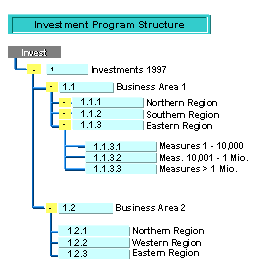
Investment Program with Its Positions