 Control Functions of the Investment Profile
Use
The most important control feature from the perspective of
Investment Management
(IM) is the investment profile. By assigning an investment profile to an order or WBS element, you make it into an investment measure.
Features
When you create an investment measure, the investment profile controls the following:
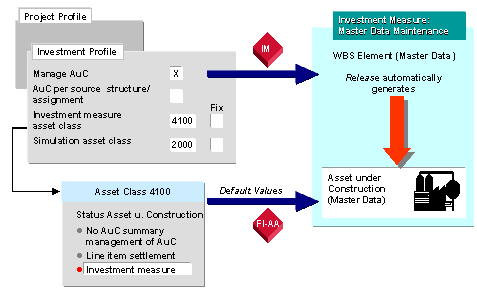
Creation of an asset under construction for the investment measure
Creation of master data for the depreciation forecast
Asset under Construction
You make the following specifications in the investment profile:
Automatic creation of an accompanying asset under construction when the order or WBS element is released
An asset under construction, per source structure and source assignment
Using this indicator, you control whether the system creates exactly one asset under construction per investment measure, or one asset under construction per assignment in the source structure. The system then charges all of the cost elements belonging to one source assignment to the source assignment’s own individual asset under construction. When you set this indicator, you can assign each investment profile its own default asset class per source assignment (in Customizing for
Investment Management
, choose
Define Assignment of AuC Classes per Source Assignment
).
For more information on the source structure, see Settlement Rules .
Asset class to be used when the accompanying asset under construction is created. Using the
Fixed default class
indicator, you specify whether this is a default value that can be changed or not.
Summary or line item settlement
This indicator controls whether the periodic settlement and full settlement of investment measures should be by line item or by totals. Line item settlement has the following advantages:
You can create settlement rules for individual line items (debits). When you use summary settlement, you are limited to entering blanket settlement rules for the whole measure, or for certain cost element groups.
– It is possible to trace the origins of each line item from the completed asset back to the original debit on the investment measure. In the case of summary settlement, an audit trail is available by cost elements only.
The advantages of line item settlement, however, are offset by reductions in performance. Therefore, you should use line item settlement only if it is really needed.
Depreciation Simulation
Asset class to be used to default the depreciation terms for the depreciation simulation (refer to Depreciation Simulation ). Using the
Fixed default class
indicator, you specify whether this is a default value that can be changed or not.
 Caution
You can only enter the default asset class manually if the investment measure is not released immediately after being created. When the investment measure is released immediately, the asset under construction is also created immediately (without your being able to change the asset class).
You ensure the consistency of the depreciation terms for all distributions in an asset class by setting the
Ident. valuation
indicator.
Distribution rules for the depreciation simulation
Functions of the Investment Profile
Activities
You maintain investment profiles in Customizing for
Investment Management
. Choose
Internal Orders as Investment Measures
or

Projects as Investment Measures

Master Data
Define Investment Profile
 .
.
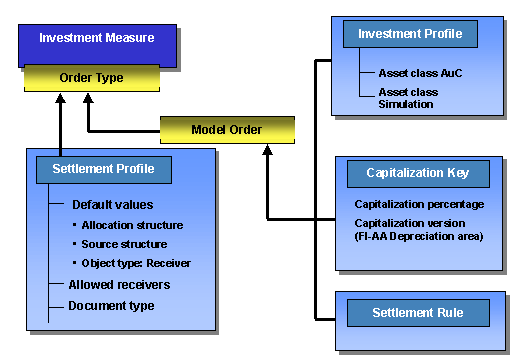
There are two ways of assigning an investment profile to an investment order. Either you can enter it directly in the master record of the order on the
Investment
tab page, or you can enter in a model order, also on the
Investments
tab page. The system determines the model order by the order type used when you create the order. For order types for investment measures, therefore, you should specify the following:
Assign a model order to the order type (Customizing for
Internal Orders
:
Order Master Data
Define Order Types
).
Assign an investment profile to this model order (Customizing for
Internal Orders
:
Order Master Data
Screen Layout
Define Model Orders,
choose the
Investments tab page).
Control Elements of Order Type and Model Order
There are also two ways of assigning an investment profile to a WBS element. You can either enter it directly in the WBS element master record on the
Investment
tab page, or assign it by means of the project profile used when creating the WBS element.
You assign the investment profile to the project profile in the Customizing definition of the project profile (on the
Controlling
tab page). The system uses the investment profile specified in the project profile as a default when you create the project. The investment profile specified in the project definition is also used as a default when individual work breakdown structure (WBS) elements are created. For WBS elements that are not to be capitalized, you can manually remove the investment profile (on the
Investment
tab page).
You can also define orders and WBS elements as investment measures at a later date (after their initial creation). You do this by assigning an investment profile to them The system then automatically creates the accompanying asset under construction. However, this procedure is only possible if the order or WBS element has not yet been settled.
See also:
Implementation Guide (IMG) of
Investment Management
under
Internal Orders as Investment Measures
or
Projects as Investment Measures
Master Data
Define Investment Profile.