 Phase Scheduling
Use
The system uses this function in process order or master recipe scheduling to determine the start or finish dates of the phases.
Prerequisites
You have chosen a scheduling type that allows phase scheduling (see Scheduling Type Definition ).
Phases are not scheduled in scheduling types with the
Only capacity requirements
indicator. In this case, the system uses the scheduled start and finish dates of the recipe or order for the phases.
A control key has been assigned to the phase in which the
Scheduling
indicator has been set (see Control Key ).
If the
Scheduling
indicator has not been set in the control key, the system assumes that the phase duration is 0, that is, the start and finish dates of the phase are identical. When determining the recipe or order dates, the system takes the relationships and the offset defined in these relationships into account (see below).
Features
How the system schedules the phase depends on whether it is marked as an internally or externally processed phase in the control key.
Scheduling Internally Processed Phases
First, the system calculates the processing time using the formula defined in the primary resource for the scheduling basis.
Depending on how the formula was defined, the following parameters are used for the calculation (see Formulas ):
Standard values of the phase
The base quantity of the phase along with the phase quantity, which may have been determined in material quantity calculation
User-defined fields of the phase
Formula constants of the resource
The system uses this information to determine the phase dates taking the following criteria into account:
The scheduled dates of the recipe or order (see Process Start and Finish Dates Scheduling )
Phase scheduling starts from:
The scheduled start of the recipe or order (in forward scheduling)
The scheduled finish of the recipe or order (in backward scheduling)
The processing time of the phases and the operating time of the resources (see Available Capacity )
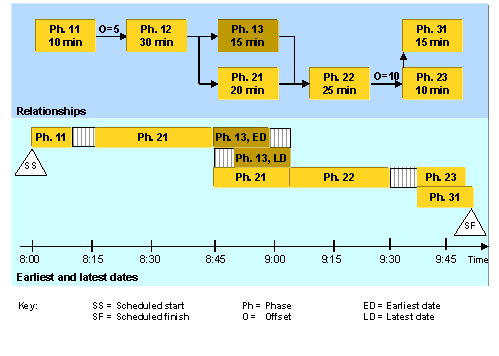
Phases are displayed on the time axis according to the operating time of their primary resources (see graphic).
In this way, the actual duration and phase dates are determined.

The relationships between the phases (see Relationship Editing )
The phases are scheduled in the sequence in time that is specified in the relationships (see graphic).
Offsets defined in the relationships are added in between the phases. They are based on the calendar defined in the relationships or, if you have not specially defined it, the factory calendar valid for your entire plant.
If no SS or FF relationships have been defined for two parallel phases of different durations, the system determines two dates for the shorter phase:
An earliest date at the beginning of the parallel phase
A latest date at the end of the parallel phase
Scheduling Externally Processed Phases
In externally processed phases, you determine which data is to be used for scheduling by defining the control key. You have the following options:
Scheduling using standard values
In this case, the system determines the phase dates in the same way as for internally processed phases (see above).
Scheduling using planned delivery time
In this case, the system takes the following parameters into account when determining the phase dates:
Planned delivery time and Gregorian calendar:
The system bases duration on the planned delivery time of the phase (see
General Data
screen,
External Processing
group box). It then lines up the phase duration along the time axis based on the Gregorian calendar.
Relationships:
The same rules apply as for internally processed phases (see above).