Environmental Instrument
An environmental instrument is a financial instrument that serves as a market mechanism to fight against climate or environmental changes. They can be traded on the secondary market. Examples of environmental instruments include emission (or carbon) allowances and carbon offsets.
The SAP Financial Services Data Management data model helps you to represent environmental instruments such as emission allowances.
Emission Allowance
An emission allowance gives the holder a legal right to emit one ton of carbon dioxide (CO2) or a carbon dioxide equivalent (CO2e) greenhouse gas during a specified period.
Emission allowances are allocated free of charge to regulated emitters by the regulators or they can be bought at government auctions. Emitting companies that exceed their allocated amounts must either pay a fine or purchase additional emission allowances, for example, under the EU Emissions Trading Scheme (ETS). Companies emitting less than the allocated emission allowance can sell their excess allowances at government auctions or trade them in the secondary market.
Examples of emission allowances include Certified Emission Reduction (CER) units, Emission Reduction Units (ERUs), or European Union Allowances (EUA) that are traded under the EU ETS.
Emission allowances are without financial claims on receivables or securities. There can be exchange-traded derivatives (ETD) and over-the-counter (OTC) derivatives where the underlying instrument is an emission allowance.
Data Model
Emission Allowance - Financial Instrument
The Markets in Financial Instruments Directive (MiFID II) classifies emission allowances as financial instruments.
In SAP Financial Services Data Management, emission allowances are treated as financial instruments.
The following figure illustrates how the Emission Allowance diagram in the conceptual data model (CDM) helps you to model emission allowances:

Exchange-Traded Derivatives (ETD) Based on Emission Allowance
ETD futures and ETD options on emission allowances can be represented in the data model by using the Instrument Futures Specification and Instrument Options Specification entities respectively.
The following figure illustrates how the Derivative Contract Specification diagram can be used to model ETD futures based on emission allowances:

The following figure illustrates how the Derivative Contract Specification diagram can be used to model ETD options based on emission allowances:

Environmental Instrument Trade
You can use the trade category Environmental Instrument Trade in the Trade diagram to represent an environmental instrument trade.
The non-generated 1:n relationship Securities Account for Environmental Instrument Trade between the Securities Account and Environmental Instrument Trade entities enables you to assign a securities account to the traded environmental instrument.
The non-generated 1:n relationship Traded Environmental Instrument between the Environmental Instrument and Environmental Instrument Trade entities enables you to assign an environmental instrument to the traded environmental instrument.
The following is an example of how an environmental instrument trade can be represented in the CDM:

Environmental Instrument Position
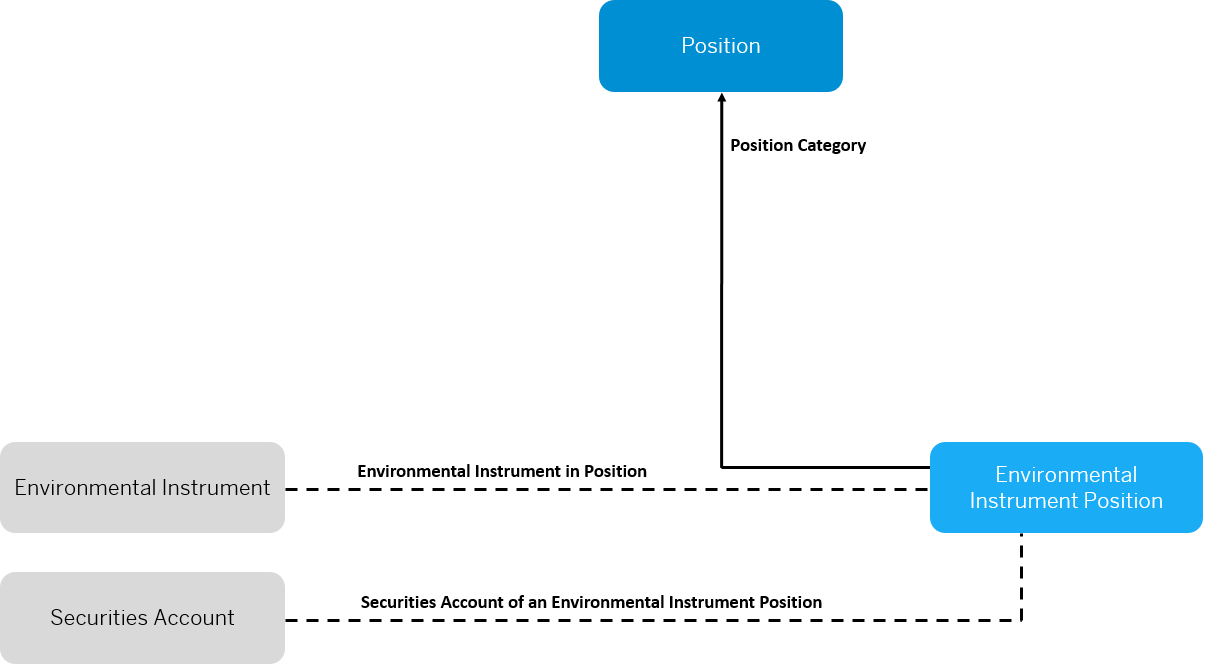
You can use the position category Environmental Instrument Position in the Position & Lot diagram to represent an environmental instrument position.
The non-generated 1:n relationship Securities Account of an Environmental Instrument Position between the Securities Account and Environmental Instrument Position entities enables you to assign a securities account to an environmental instrument in a position.
The non-generated 1:n relationship Environmental Instrument in Position between the Environmental Instrument and Environmental Instrument Position entities enables you to assign an environmental instrument to a position.
The following is an example of how an environmental instrument position can be represented in the CDM:
More Information
-
For more information, see the related entities and their definitions in the data model represented in SAP PowerDesigner.