Interpolation Methods
Use
Two kinds of interpolation methods can be applied to keys: linear and TCB (tension, continuity, and bias – smooth).
Features
Linear Interpolation
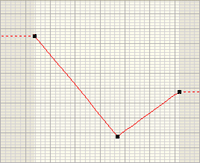
The Linear interpolation method creates a uniform rate of change between keys that manifest in a mechanical type of animation. It requires only two keys to function. This method always creates straight lines between the keys with sharp corners at the key itself.
TCB Interpolation
The TCB interpolation method creates a smooth rate of change through and between keys. If the previous and next keys also use TCB interpolation, the shape of the curve near the previous or next keys also change. It requires at least three keys to be able to see the smooth change.
A key with linear interpolation in a series of segments of smoothly interpolated keys creates a sharp corner at a point in time where the linearly interpolated key is located. This method is helpful when you want to softly animate the movement of a model.

TCB Interpolation Values
TCB interpolation uses three values to fine tune the appearance of the keys: tension, continuity and bias.
-
Tension: Controls how sharply the curve bends at the key.
-
Continuity: Controls how smoothly the curve moves “through” the key.
-
Bias: Controls the balance between the curve before and after the key.