Stocking According to BOM Characteristics
The aim of determining a stocking indicator based on BOM characteristics is to be able to comply with an accepted market delivery time or maximum total replenishment lead time through systematic stocking.
To determine the stocking indicator by means of BOM characteristics, first select the relevant checkbox on the selection screen.

SLM now uses the cumulated replenishment lead times over several BOM levels to check when stocking should take place. Relevant parameters that are checked are the Accepted Market Delivery Time and Maximum Total Replenishment Lead Time. You can determine these parameters yourself in planning and maintain them in the enhanced material master view. Both values are maintained in calendar days. It is also possible to work with only one of the two parameters.
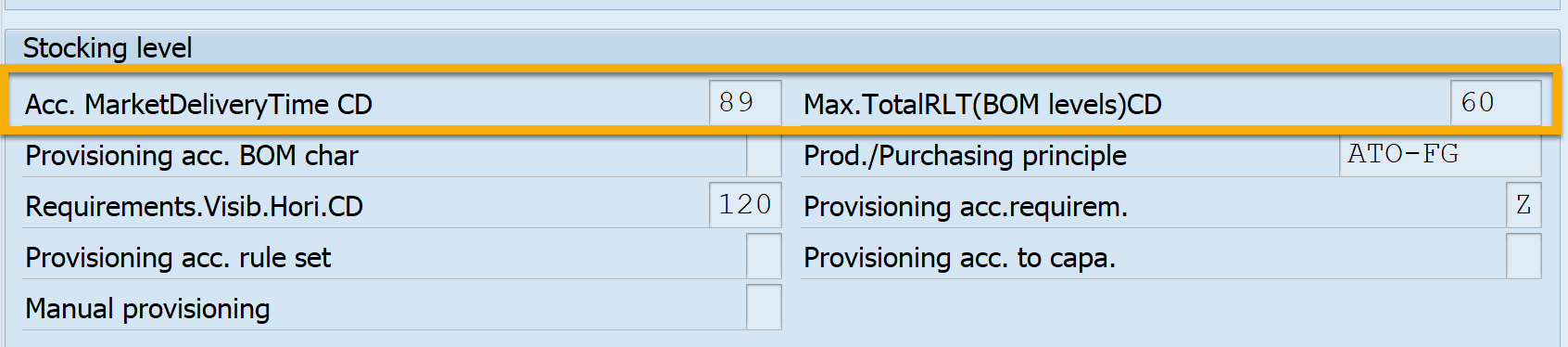
For the accepted market delivery time, it is still possible to determine a calculated value and then use it in the analysis. You make the necessary settings in the XMD section of the selection screen.
You can define which replenishment lead time is used in the check for each material in the enhanced material master view:
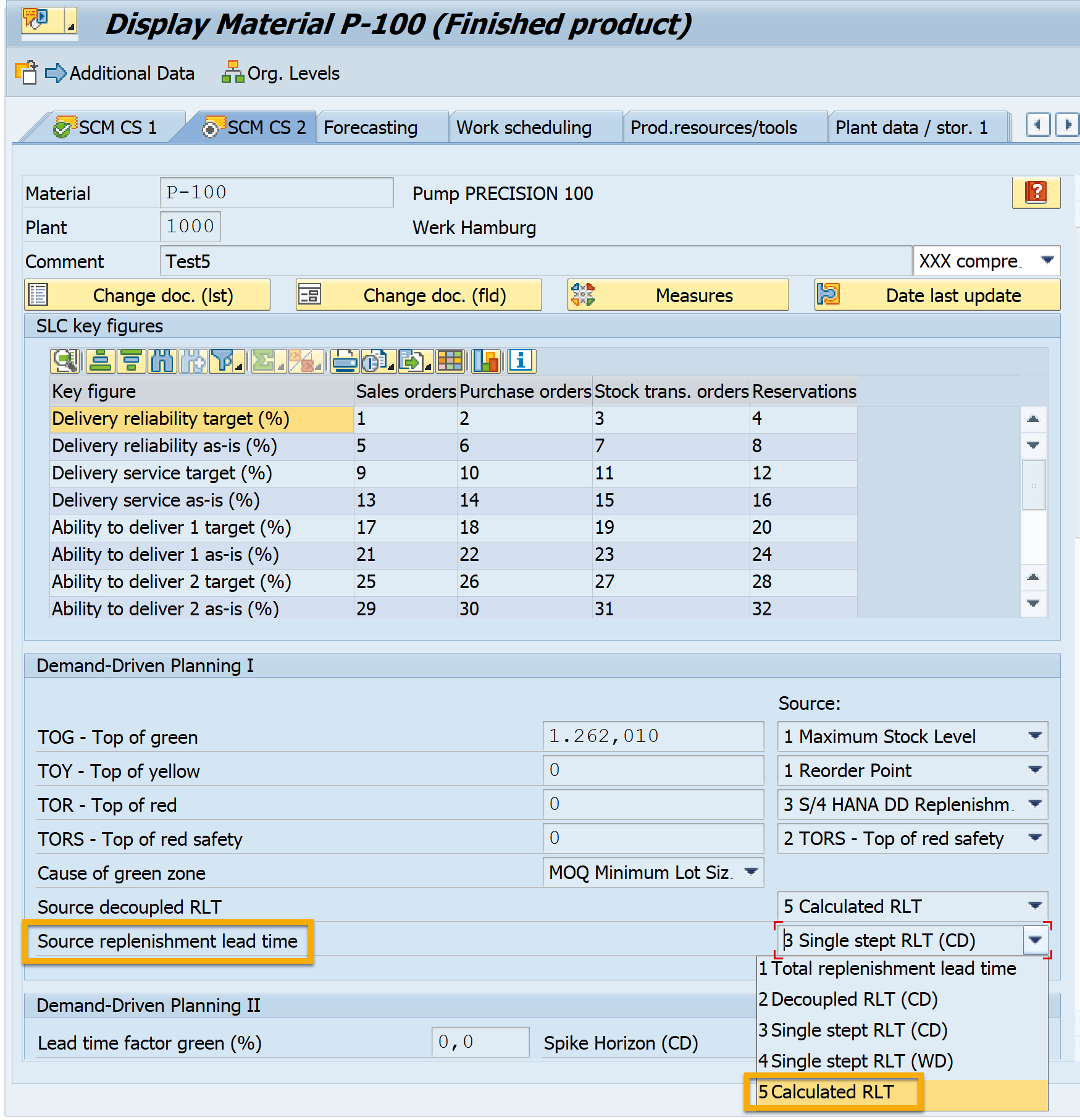
In the enhanced material master view, you can use the dropdown list to select which replenishment lead time is to be used. The following overview illustrates the origin and calculation of the different replenishment lead times.
Calculated RLT
Inhouse production
1) Lot-size-independent RLT = inhouse production time (MRP 2, workdays) + goods receipt processing time (MRP 2, working days)
2) Lot-size-dependent RLT = setup time + processing time x lot size / base unit of measure + interoperation time (all parameters in work scheduling view, working days) + goods receipt processing time (MRP 2, working days)
Approach to lot-sizing for lot-size-dependent RLT:
Use fixed lot size (if fixed lot size available), otherwise use base unit of measure while taking minimum/maximum lot size into account.
External procurement
Purchasing processing time (plant Customizing, working days) + planned delivery time (MRP 2, calendar days) + goods receipt processing time (MRP 2, working days)
The parameters Decoupled RLT (CD), One-Level RLT (CD), and One-Level RLT (WD) are read from the enhanced material master view.
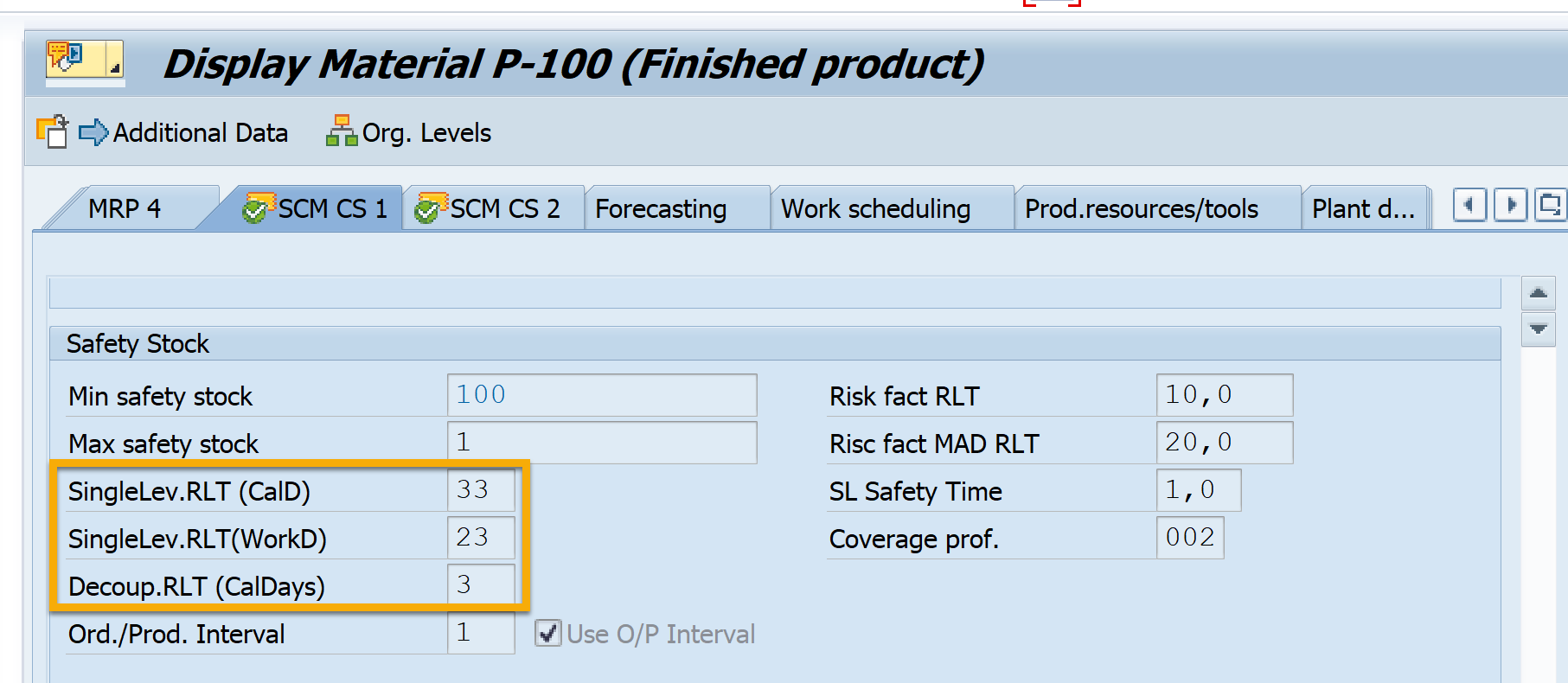
Note that working days are converted to calendar days for the calculation within SLM. For this, the values are multiplied by 7 and divided by 5.
The following example illustrates the determination logic of the stocking indicator based on BOM characteristics.
Depending on which criterion is used to make the stocking decision, a different identification code is assigned for the stocking indicator.
The following stocking indicators are available:
- M – Stocking according to market delivery time
- S – Stocking according to maximum total replenishment lead time
- X – Stocking according to accepted market delivery time and maximum total replenishment lead time
The determination or update takes place in accordance with the defined stocking level. You differentiate between the following:
- Same stocking level
- Individual stocking level
In the case of the same stocking level, stocking always takes place for an entire BOM level as soon as a stocking indicator is set for a component/assembly of this level.
In the case of the individual stocking level, the system checks for each branch of the BOM where stocking is to take place. Stocking does not take place at the level of an entire BOM level, but individually for each material.