 CIM
Concept
CIM
Concept 
The Common Information Model (CIM) is a standard of the Distributed Management Task Force (DMTF) and is based on the object-oriented modeling approach. This standard provides a neutral implementation schema to describe management information within a computing environment.
Object-oriented modeling is a means of representing the real world. CIM is designed to model hardware and software elements. The following are basic terms associated with this concept:
· Class and inheritance
· Instance
· Association and reference
· Schema
Class and Inheritance
A class is a collection of objects that have similar properties. It is a template for a type of object. CIM supports the inheritance concept so that classes in the context of CIM are organized hierarchically.
Inheritance is an object-oriented concept. A class automatically has all the properties of the class from which it is derived. The class that passes on properties is called the superior class. The class that inherits properties from a superior class is called the subclass. A subclass represents a specialization of the superior class by enhancing it with additional properties.
There are also abstract classes. These are classes that do not have a particular form, but which represent the superior class for one or more subclasses.
Example
The CIM class SAP_Product defines the number of SAP products that have joint properties such as the same product name, version, and so on.
Instance
An instance is a form of a class, or an object of
the class. All properties defined in the class have fixed values in an
instance. The CIM class SAP_Product can have instances such as
mySAP CRM and R/3 Enterprise. An instance has
certain properties. A class declares some of these properties as key
properties. The CIM concept uses key properties to clearly identify instances
of a class. This identification is also known as the name of an instance. This
means that there are no two instances of one class whose key properties are
completely identical. Key properties are mandatory for any given
instance. The CIM class SAP_ProductLine declares Vendor and Name as key
properties. In addition, this class also has properties such as Caption and Description. The
product CRM IPC differs completely from other
products with the name
sap_productline.name="CRM IPC",vendor="sap.com"
. Qualifiers contain
metainformation that describes classes, instances, and properties in more
detail. Many CIM classes or
their instances have a Caption property. This
property is a short description and has, among other things, a maxlen qualifier, which restricts the length of the
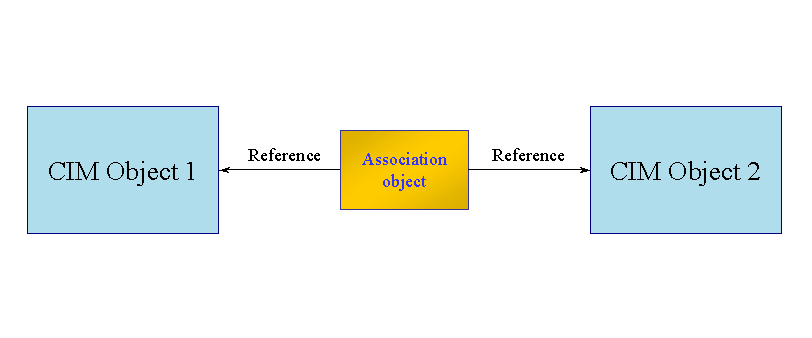
description. Associations are a
type of class that represent relations between classes or their instances. An
association has one or more references as properties, which refer to
corresponding CIM instances. In this way you can define relations between
classes or their instances, without affecting the definitions of the classes
concerned. The association class
SAP_ApplicationSystemHost represents the connection between a computer
(hardware) and the SAP system (software) running on this computer. A schema in CIM is
a collection of classes and has a name. You use a schema to name a class. A
CIM class can belong to one schema only. You name a schema, class, and
property in CIM by using the syntax schemaname_classname.propertyname. The CIM standard
contains a number of class definitions that represent the common model. This
common model is called the CIM schema. You can extend this common model by
adding technology-specific class definitions. These extensions are referred to
as extension schemas. All CIM classes in
the examples above belong to the SAP extension schema, which represents an
enhancement of the CIM schema.
Example
Property and Key
Property
Example
Qualifier
Example
Association and
Reference
Example
Schema
Example
